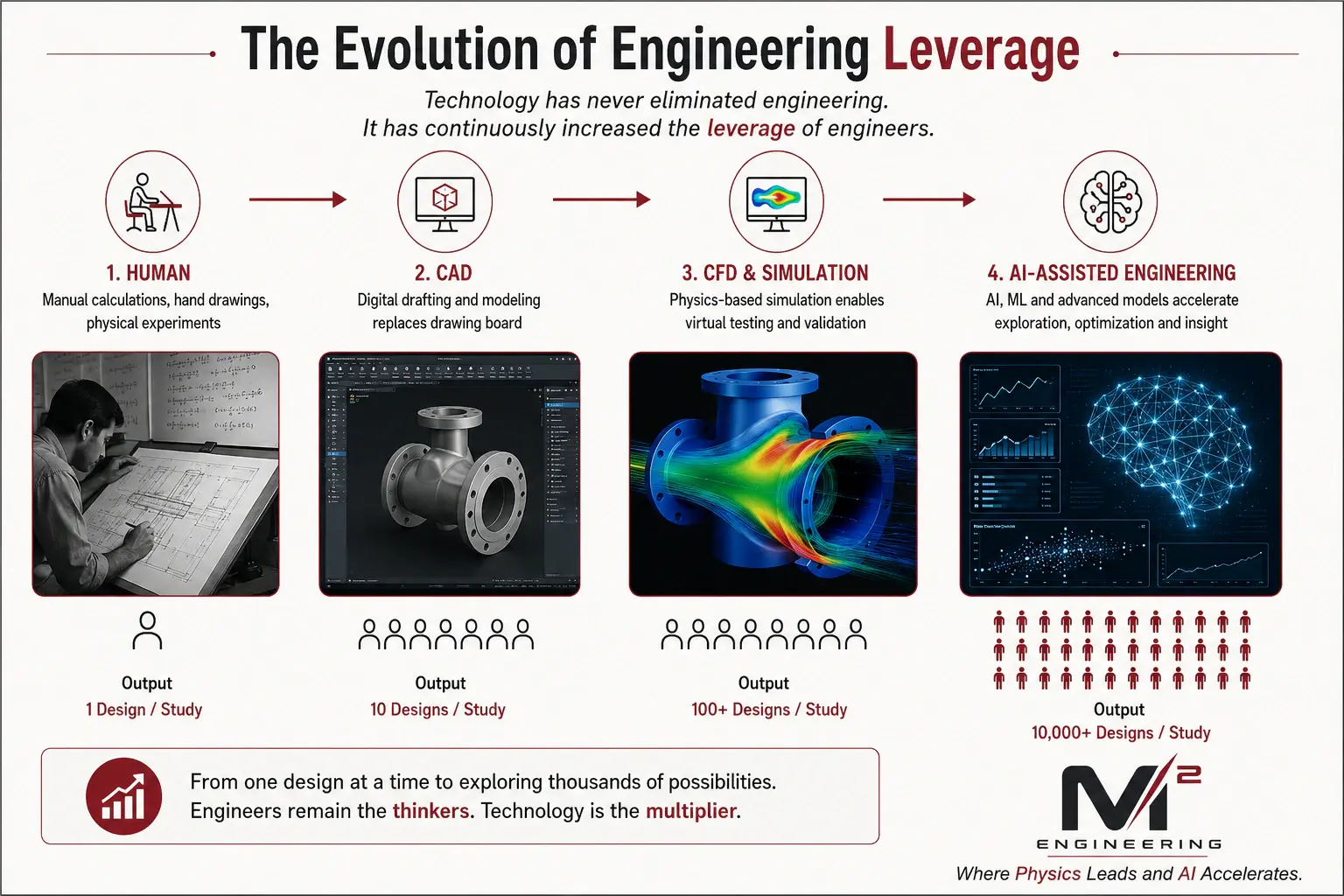
A few months ago, I found myself thinking about how engineering work has changed over the past fifty years. Not the technology itself, but the amount of leverage available to an individual engineer.
An engineer sitting at a drafting table in the 1970s could only evaluate a limited number of design concepts before committing to a direction. Every calculation required time, every drawing was manual, and every iteration carried a significant cost. Then CAD arrived and dramatically expanded what a single engineer could accomplish. Later came simulation tools, allowing engineers to evaluate ideas in a virtual environment before building physical prototypes. CFD, finite element analysis, and coupled-physics simulation did not replace engineers. They increased the number of questions engineers could answer before making a decision.
Artificial intelligence represents the next step in that evolution.
This is why I sometimes find the discussion around AI slightly misleading. Much of the conversation focuses on whether AI will replace people, as though replacement is the primary objective. Historically, that has never been how technology works. Organizations adopt new technologies because they increase productivity. The steam engine reduced the need for manual labor. Industrial machinery increased manufacturing output. Computers reduced the amount of clerical work required to run a business. AI follows the same pattern. It allows individuals and organizations to accomplish more work with fewer resources.
That reality makes many people uncomfortable because knowledge work has long been viewed as relatively protected from automation. Manufacturing jobs experienced this transformation decades ago, but writing, programming, research, design, and engineering were often considered fundamentally different. Today, that assumption is being challenged. AI is demonstrating that many tasks traditionally associated with knowledge workers can also be accelerated, assisted, and in some cases automated.
Within engineering, this often leads to the question of whether AI will replace engineers. In my view, the more useful question is what part of engineering actually creates value. Is the value in running a simulation, or is it in knowing which simulation should be run? Is the value in generating data, or is it in determining whether the data can be trusted? Those are very different activities, and understanding the difference is becoming increasingly important.
Many routine engineering tasks are already becoming more automated. Running simulations, generating reports, processing large datasets, and performing optimization studies require far less manual effort than they did even a decade ago. Emerging technologies such as surrogate models, neural operators, and AI assisted workflows are accelerating this trend further. A design study that once required hundreds of expensive simulations may eventually be explored through models capable of evaluating thousands of design variations in a fraction of the time.
From a productivity perspective, this is remarkable. However, the role of the engineer does not disappear. It evolves. As computational tools become more capable, the value of engineering judgment increases rather than decreases. Engineers spend less time generating information and more time defining problems, validating assumptions, interpreting results, and ensuring that conclusions remain grounded in physical reality.
This distinction is particularly important because physical systems do not care whether a prediction originated from a machine learning model, a CFD simulation, or a spreadsheet. Reality still answers to the laws of physics. A neural operator can approximate a CFD solution. An optimization algorithm can evaluate thousands of potential designs. A language model can summarize an entire body of technical literature in seconds. These capabilities are valuable, but none of them inherently understand whether an answer is physically meaningful. They recognize patterns. Engineers establish trust.
At M² Engineering, this is how we think about AI. Not as a replacement for engineering judgment, but as a force multiplier for it. We believe the future belongs neither to engineers who ignore AI nor to those who blindly trust it. The greatest advantage will belong to engineers who understand both the underlying physics and the computational tools available to them. Those individuals will be able to solve problems faster, explore larger design spaces, and make better informed decisions while maintaining confidence in the physical validity of their results.
AI will undoubtedly replace certain forms of human work. In many cases, that process has already begun. The larger transformation, however, is not about replacing engineers. It is about redefining where engineers create value. The most powerful combination is not AI alone. It is an engineer who understands how to use it.
Closing Thoughts
At M² Engineering, we help organizations leverage advanced simulation, coupled-physics modeling, and AI enabled engineering workflows to solve complex thermal, fluid, and process engineering challenges. Our objective is not simply to accelerate engineering analysis, but to ensure that faster decisions remain grounded in physical reality.
The engineering organizations that thrive over the next decade will not necessarily be those with access to the most AI tools. They will be those that successfully combine deep physical understanding with intelligent computational workflows.
That is the future we are building toward at M² Engineering.
Where Physics Leads and AI Accelerates.