Walk into any engineering museum and your eyes go straight to the biggest machines in the room: a steam engine with flywheels taller than you are, a bridge truss put together bolt by bolt, or a cutaway of an early jet engine. These things come from completely different eras, but they all tell the same story. The engineers who built them didn’t have simulation software. They worked with paper, pencils, slide rules, and a lot of careful math. A single technical drawing might go through three or four rounds of revisions, each one marked up in red pencil by someone else on the team. Every line on that paper carried real weight: hours of discussion, double-checking, and the heavy responsibility of making decisions without ever seeing the finished machine run.
Computers changed engineering more dramatically than almost anything else in the profession. Drafting tables disappeared. Calculations that used to take whole teams weeks could suddenly be done in minutes. Wind tunnel tests got paired with computational fluid dynamics, structural testing with finite element analysis. We could suddenly explore things our predecessors could only guess at. But here is the funny part. Instead of making life simpler, the better tools just let us tackle harder problems. Designs got more ambitious, products became lighter and more efficient, and customers started demanding perfection on tighter schedules. The complexity grew faster than the computers could keep up.
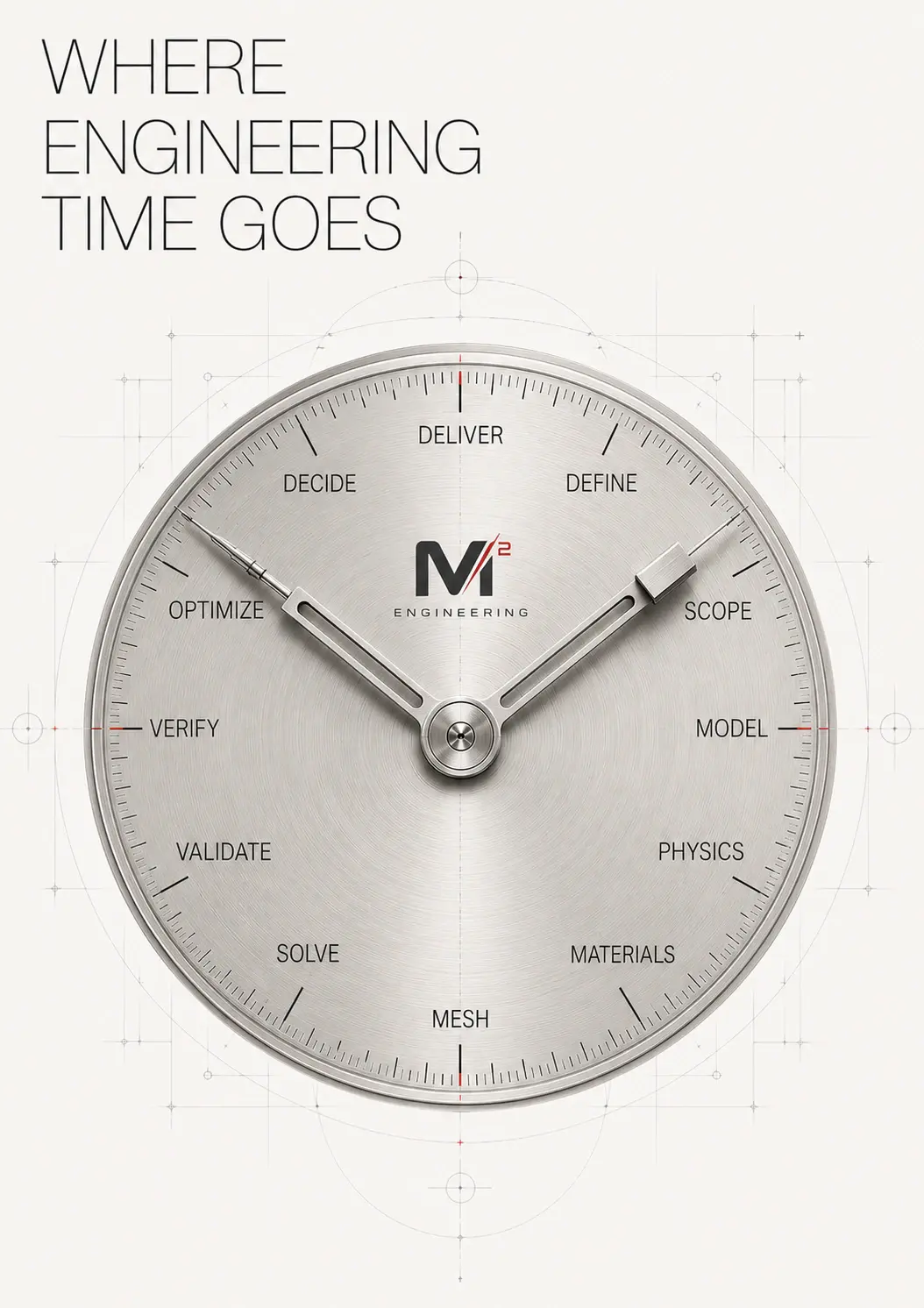
If you walk into a real engineering office today, you will probably notice something that surprises people outside the field. The first thing on most desks isn’t the fancy simulation software. It’s a notebook. I still catch myself and plenty of colleagues sketching flow paths or roughing out heat transfer ideas with a pencil before we ever touch the computer. Paper is just faster for testing whether an idea is even worth pursuing. Before any simulation starts, we often spend hours, sometimes days, just trying to really understand the problem. More than once, my team has spent longer arguing about boundary conditions and what physics actually matters than the solver spent actually running. You have to decide which forces to include, which bits of geometry you can simplify, and whether the behavior you’re seeing is real or just a modeling artifact.
Take something like a pressure vessel or a radial liquid-cooling network for a 300 mm silicon wafer that has to run reliably for years. You can never know exactly how every weld will hold up, how operating conditions will drift over time, or how materials will age under constant cycling. Engineering is really about steadily chipping away at those unknowns until you’re confident enough to say, “Yes, we can build this and it’ll be safe.” That’s why we do validation studies, mesh independence checks, and physical prototypes. Each one knocks down a different source of doubt. It’s slow, deliberate work, and no amount of computing power can rush the judgment part.
As automated tools and machine learning start showing up more in industry, everyone talks about productivity and automation. I remember older engineers who kept slide rules in their shirt pockets long after calculators were cheap. Not because the slide rule was better, but because it was how they thought. Habits like that die hard. The tools will keep getting faster, the models bigger, and the automation smarter. But at the end of the day, the person who has to decide what to trust, what to question, and what’s actually worth building will still be the engineer. That responsibility has outlasted every tool we’ve ever invented, and I don’t see anything on the horizon changing that.