Most engineering teams are organized by component, so you’ve got one group on the reactor, another on the heat exchanger, a third handling controls, and someone else tracking cost, and sure, you have to break things up that way or you’d never get anything built. The issue is when performance reviews lock onto those local metrics, then the reactor team is chasing conversion at all costs, thermal team is obsessed with smoothing out every temperature wiggle, mechanical team wants pressure drop as low as possible, and controls team are tuning for blistering response times, and each group hits their numbers beautifully while the actual integrated system ends up worse off, more expensive, harder to operate, or just plain less efficient than anyone predicted. It’s not that people aren’t trying or that the simulations are sloppy, the engineering is usually solid and every piece passes its tests, but the whole thing falls short because the physics of the real system couldn’t care less about your departmental lines or where one design responsibility ends and another begins.
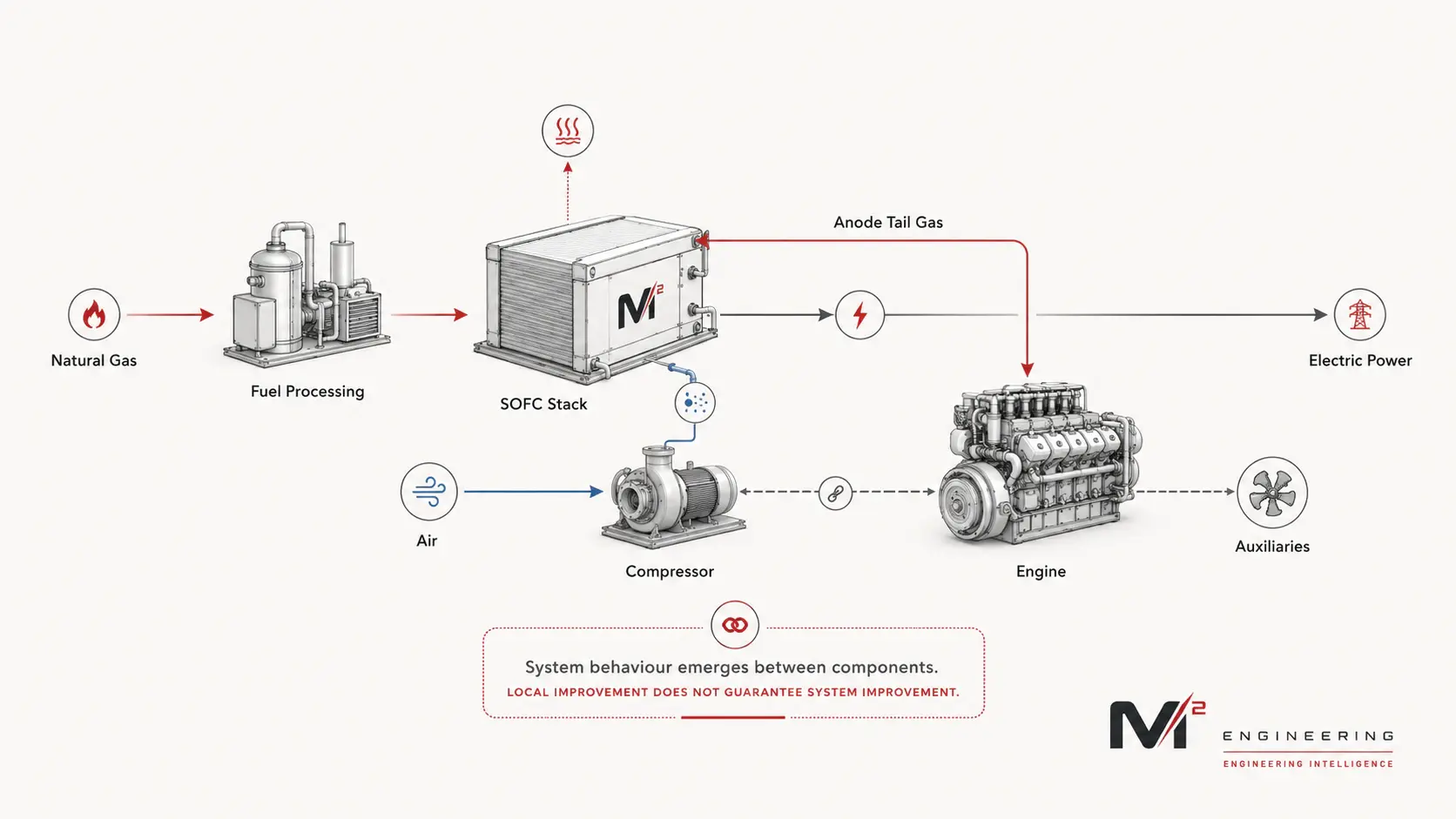
Take a hybrid power generator that pairs a solid oxide fuel cell with an internal combustion engine, it sounds straightforward enough, shoot for around 200 kilowatts from natural gas, good efficiency, competitive cost, and the fuel cell handles the heavy lifting while the engine burns whatever's left in the exhaust to squeeze out extra power and run auxiliaries, and on paper that looks like a neat marriage of both technologies. The catch is those two machines are tied together through fuel composition, pressure, temperature, airflow, shaft power, and control logic in ways that aren't always obvious, so a tweak that helps the stack might wreak havoc on the engine, and a change that makes the engine run smoother can completely mess with the conditions the fuel cell needs, which means the real problem isn't how well either unit performs by itself but how the whole system behaves when they start pushing and pulling on each other.
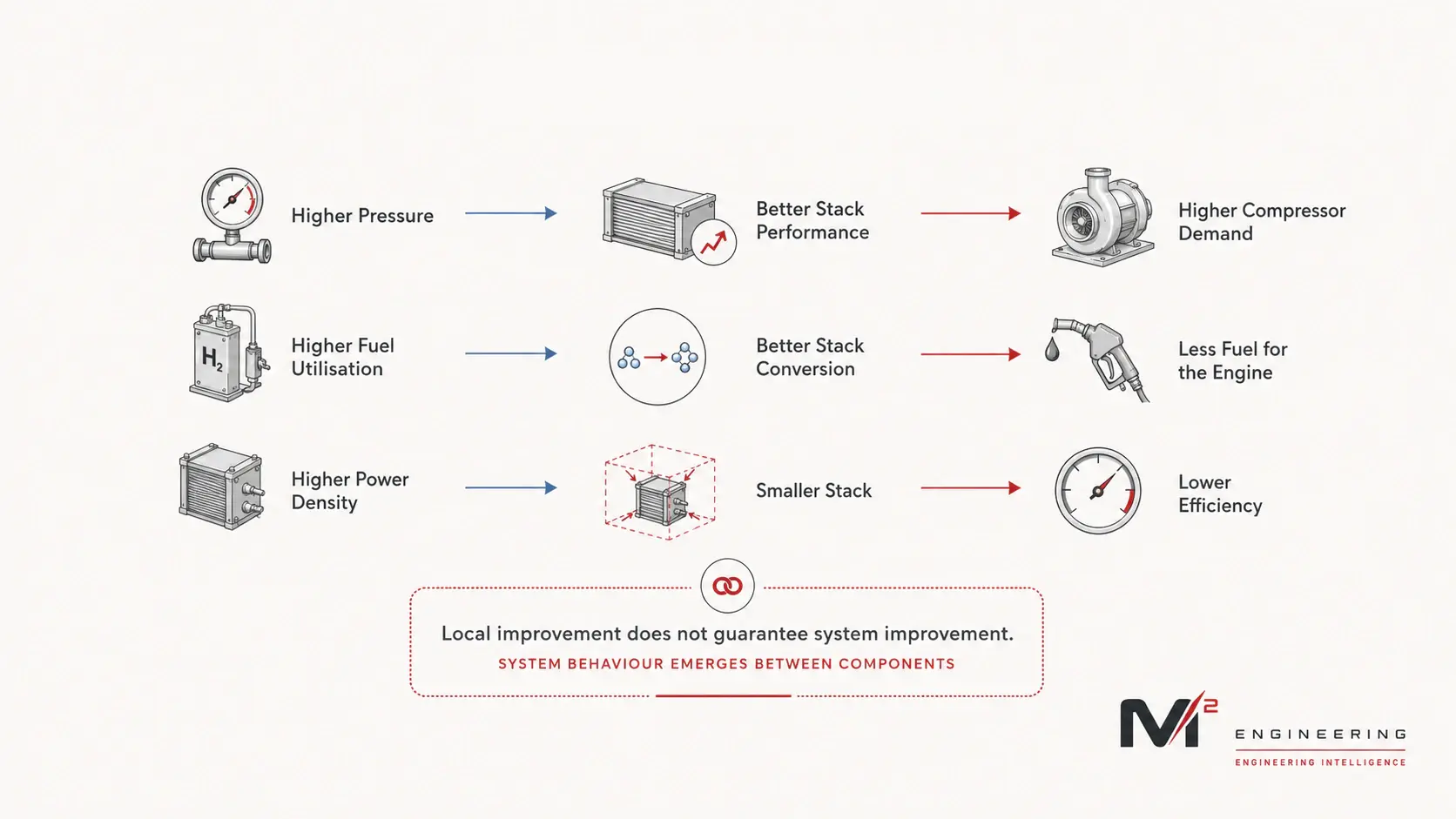
Pressure looked like an easy win early on, crank it up and the fuel cell performs better, more power from the same active area, so from the stack team's viewpoint higher pressure is fantastic because it boosts power density and lets you shrink the assembly and save cost, but then you zoom out to the whole system and things get messy because higher pressure means the compressor has to work harder, and that compressor is sucking shaft power from the engine, which itself depends on how much unburnt fuel is left in the exhaust from the fuel cell, so that pressure increase that made the stack look great might actually load up the engine and eat away at your net gain. You see the same thing with fuel utilization, burn more fuel inside the stack and you get better direct electrochemical conversion, sure, but now there's less energy left over for the engine, and if the stack gets too greedy the engine might not have enough oomph to run the auxiliaries, forcing you to tap electricity from the stack itself to make up the difference, so what seemed like a smart move for one component ends up costing you at the system level.
Power density was another nasty trade-off because running the stack harder cuts down the cell area you need and looks cheaper on capital costs, but push it too far and losses climb while efficiency tanks, yet run it gentler and you get better efficiency at the price of a bigger, pricier stack, so neither extreme is really right and you end up juggling pressure, fuel utilization, stack size, engine output, compressor demand, thermal management, and cost all in one messy balancing act. Then you've got dynamic behavior piling on more headaches because a steady-state point that looks perfect in simulation can still be a nightmare during startup, load changes, or temperature swings, since high-temperature systems respond slowly and a decision you make now might not show its full effect on critical temperatures for several minutes, which means your modeling can't just nail one operating point and call it done, you have to map the whole envelope, figure out where the physical limits are, and give the control system enough lead time to keep things from drifting into unsafe or inefficient zones.
This is where simulation either turns into real engineering insight or just stays a fancy math exercise, because a detailed model can spit out temperatures, flows, voltages, conversion rates, and pressure drops all day long, but those numbers don’t automatically tell you what to actually build. The real payoff comes when the model is backed by real experiments, when you actually understand the key interactions instead of just assuming them, and when you translate all that output into concrete decisions about architecture, equipment sizing, operating limits, and control strategy, and the most useful model isn’t necessarily the biggest or most computationally intensive one out there, it’s the one that captures the physics that actually matters for your important decisions with enough accuracy that you trust it and enough speed that you can run it over and over. Sure, AI can help by speeding up design exploration, building fast surrogate models, and finding patterns in large datasets, but it can’t decide for you which conservation laws are worth keeping, whether your training data actually represents something physically real, or whether that “optimal” solution the algorithm found is quietly breaking a critical system constraint, so physics has to define the problem first before computation or AI can do anything useful to solve it.
This same pattern shows up everywhere you look, crank up temperature in a reactor and you might speed up kinetics but create temperature gradients that kill your selectivity or damage materials, drop pressure too much in a cooling system and suddenly your heat transfer goes weak, push conversion higher in one process unit and you just shifted the burden downstream to separation, improve one device in an electrified system and now the power electronics, thermal management, or controls have to work harder to keep up. At M² Engineering, we don't treat simulation output as gospel, we use physics-based modeling, coupled system analysis, careful validation, and smart computational workflows to dig into the interactions that actually determine whether a design holds up as a complete system, and our goal isn't to crank out more plots or optimize components in isolation but to cut down uncertainty before the big decisions get made, because the best performing component doesn't add up to the best performing system, and the most important questions are almost always hiding in the space between them.