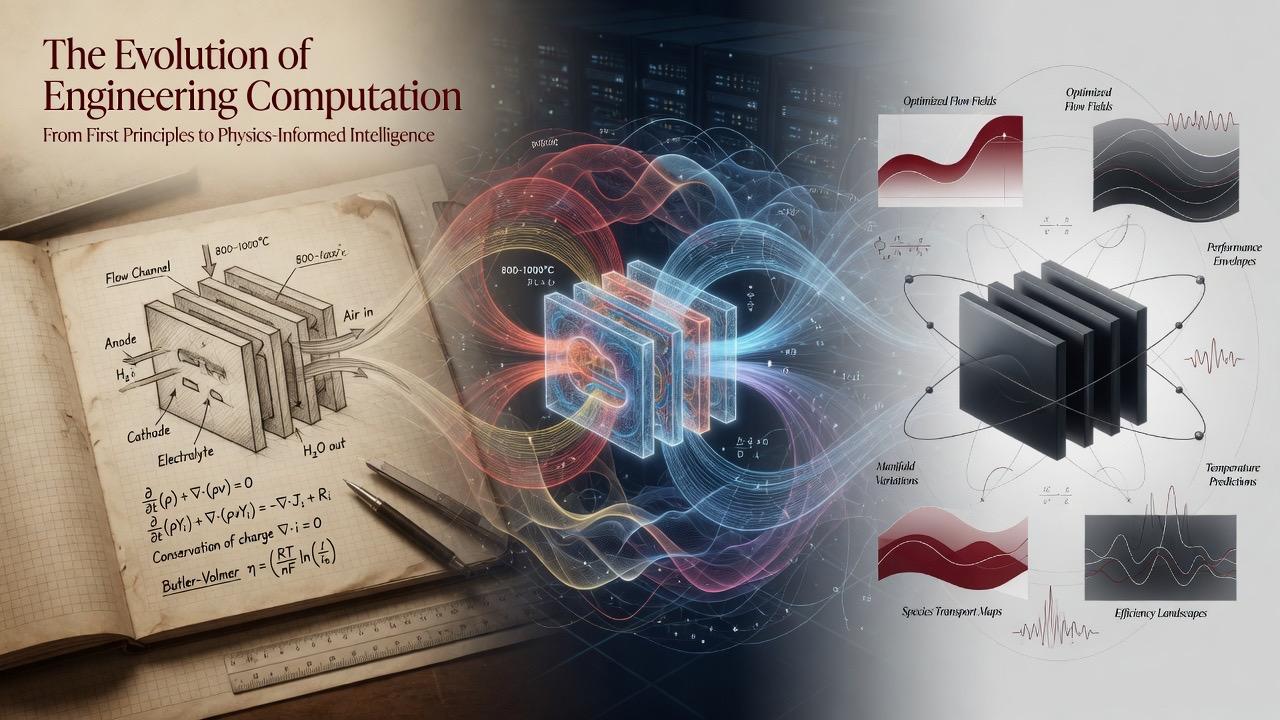
When Physics-Informed Neural Networks (PINNs) first emerged, they generated considerable excitement within the scientific computing community. For decades, engineers had relied on numerical methods such as finite element, finite volume, and finite difference techniques to solve the governing equations of physical systems. These methods were accurate and trusted, but they often required significant computational resources. PINNs appeared to offer a fundamentally different approach. By embedding governing equations directly into the training process of a neural network, they promised to combine the predictive power of machine learning with the rigor of first-principles physics.
The appeal was obvious. Instead of learning solely from data, a PINN could be constrained by conservation laws, constitutive relationships, and boundary conditions. In theory, this would allow a neural network to produce physically meaningful solutions even when experimental or simulation data were limited. Researchers quickly demonstrated PINNs on problems involving heat transfer, fluid flow, wave propagation, and reaction-diffusion systems. For a time, many believed that neural networks might eventually replace traditional numerical solvers for a large class of engineering problems.
As the technology matured, however, practical limitations became increasingly apparent. PINNs proved highly effective for inverse problems and parameter estimation, but their performance often deteriorated when applied to large-scale industrial systems. Complex geometries, strongly coupled physics problems, and three-dimensional domains frequently resulted in long training times and difficult optimization challenges. More importantly, a PINN typically learned a specific problem rather than a broad family of related problems. A model trained on one configuration often required substantial retraining when operating conditions or geometries changed. While PINNs remain an important area of research, these limitations have prevented widespread industrial adoption for routine engineering simulation.
At roughly the same time, a different branch of scientific machine learning was beginning to gain momentum. Rather than teaching a neural network to learn a single solution, researchers explored whether it could learn the underlying operator that maps problem definitions to solutions. This idea led to the development of Neural Operators and, eventually, the Fourier Neural Operator (FNO). The distinction may seem subtle, but its implications are significant. Instead of learning one temperature field or one velocity distribution, an FNO learns the broader relationship between system inputs and resulting physical fields across an entire family of problems.
For engineering applications, this capability is extremely attractive. Consider a thermal management study involving hundreds of simulations across different flow rates, channel geometries, and operating conditions. Traditionally, each design variation requires a new numerical solution. An FNO, however, can learn from a large collection of high-fidelity simulations and then generate predictions for new conditions almost instantly. Problems that once required hours of computation can be evaluated in fractions of a second. This makes Neural Operators particularly attractive for design exploration, optimization, uncertainty quantification, and digital twin applications.
Yet speed alone is not enough. Engineers are ultimately responsible for decisions governed by physical laws, not statistical accuracy metrics. A model may produce visually convincing predictions while quietly violating conservation of mass, conservation of energy, or other fundamental constraints. In engineering, such violations are not merely academic concerns; they determine whether a prediction can be trusted. A purely data-driven model may perform exceptionally well within the range of its training data yet behave unpredictably when asked to extrapolate beyond that range.
This challenge is leading the field toward what may become the next major step in engineering AI: Physics-Informed Neural Operators. Rather than viewing PINNs and Neural Operators as competing approaches, researchers are increasingly combining their strengths. Neural Operators provide the ability to learn from large simulation datasets and generate predictions at extraordinary speed. Physics-based constraints are then incorporated directly into the training process, encouraging the model to satisfy governing equations, conservation laws, and boundary conditions. The objective is not simply to reproduce simulation results but to reproduce them while remaining consistent with the underlying physics.
The implications are significant. Consider a semiconductor wafer cooling system, a fuel cell stack, or a hydrogen production reactor. A traditional workflow may require hundreds or thousands of high-fidelity simulations to evaluate design alternatives and operating conditions. These simulations can instead be used to train a Physics-Informed Neural Operator capable of predicting system behavior in real time. Because physical constraints are embedded during training, the resulting model is often more robust and trustworthy than a purely data-driven surrogate. The expensive computational effort is invested once during dataset generation, while the resulting knowledge can be deployed repeatedly through a model capable of delivering near-instantaneous predictions.
For engineering organizations, the opportunity extends beyond computational acceleration. Physics-Informed Neural Operators represent a new way of capturing and deploying engineering knowledge. High-fidelity simulations, experimental data, and decades of domain expertise can be distilled into models that remain grounded in physics while operating at speeds previously unattainable with traditional solvers. In many ways, the value is no longer the simulation itself but the engineering intelligence extracted from it.
The future of engineering simulation is therefore unlikely to be defined by a choice between physics and artificial intelligence. A more realistic outcome is the convergence of high-fidelity simulation, machine learning, optimization, and physical reasoning into a unified workflow. Physics-Informed Neural Operators represent one of the most promising examples of this convergence. They leverage the accuracy of simulation, the speed of machine learning, and the rigor of physical laws to create models capable of supporting real-time engineering decision-making.
The goal is not to replace physics with artificial intelligence.
The goal is to make physics available at the speed of engineering.
Where Physics Leads and AI Accelerates.