We Usually See Only the Beginning and the End
When we model a chemical reactor, we normally begin with reactions that are already known. We tell the computer what goes into the reactor, what products can form, and how fast the main reactions are expected to happen. This is a very useful way to work because an engineer usually wants practical answers such as conversion, temperature, product yield, heat demand, or reactor size. We recently followed this same approach at M² Engineering while studying biogas bi-reforming, where methane, carbon dioxide, and steam react over a nickel catalyst to produce a hydrogen-rich gas. The reactor model could tell us what entered, what left, and how the reactor behaved along the way. But while looking at that problem, another question became difficult to ignore. A methane molecule does not enter the reactor and suddenly become hydrogen and carbon monoxide. Something must happen between those two points. Bonds must break, atoms must move, molecules must touch the catalyst, and many small chemical steps must take place before the final products appear. At the reactor level, most of that chemistry is hidden from view.
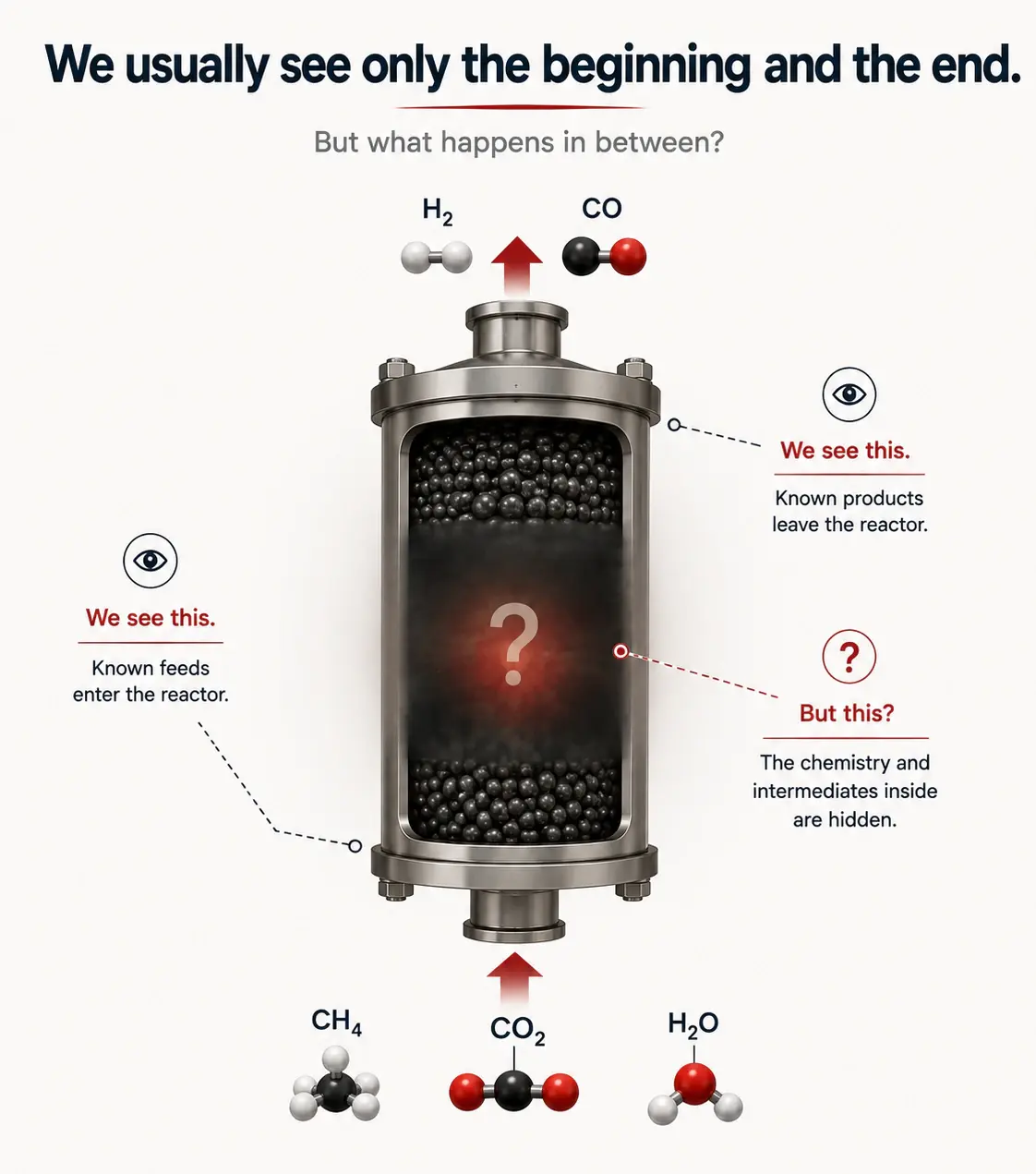
This hidden region became the starting point for our next question. Could we look inside the chemistry without first writing every possible reaction ourselves? Could we give the computer methane, carbon dioxide, steam, and a nickel surface and ask it to help build the possible steps between them? That question led us to the Reaction Mechanism Generator, or RMG.
Looking Inside the Reaction with RMG
RMG is an open-source reaction mechanism tool that grew from the work of Prof. William H. Green and his research group at MIT, together with many researchers and developers who have continued to improve the project. The idea behind RMG is easier to understand than the science hidden inside the software. Instead of telling the program every reaction that must happen, we can give it the starting chemical species and the conditions of the system, and RMG can search for possible reaction paths. For catalytic systems, it can also include molecules that sit and react on a catalyst surface. This was especially interesting for our biogas case because nickel is not simply a solid material placed inside the reactor. Its surface is where much of the important chemistry takes place. Methane, carbon dioxide, and steam can reach that surface, attach to open sites, change into smaller pieces, react with other surface species, and later leave again as products. In other words, RMG gives us a way to open the large reaction arrow and start looking at what may be happening inside it.
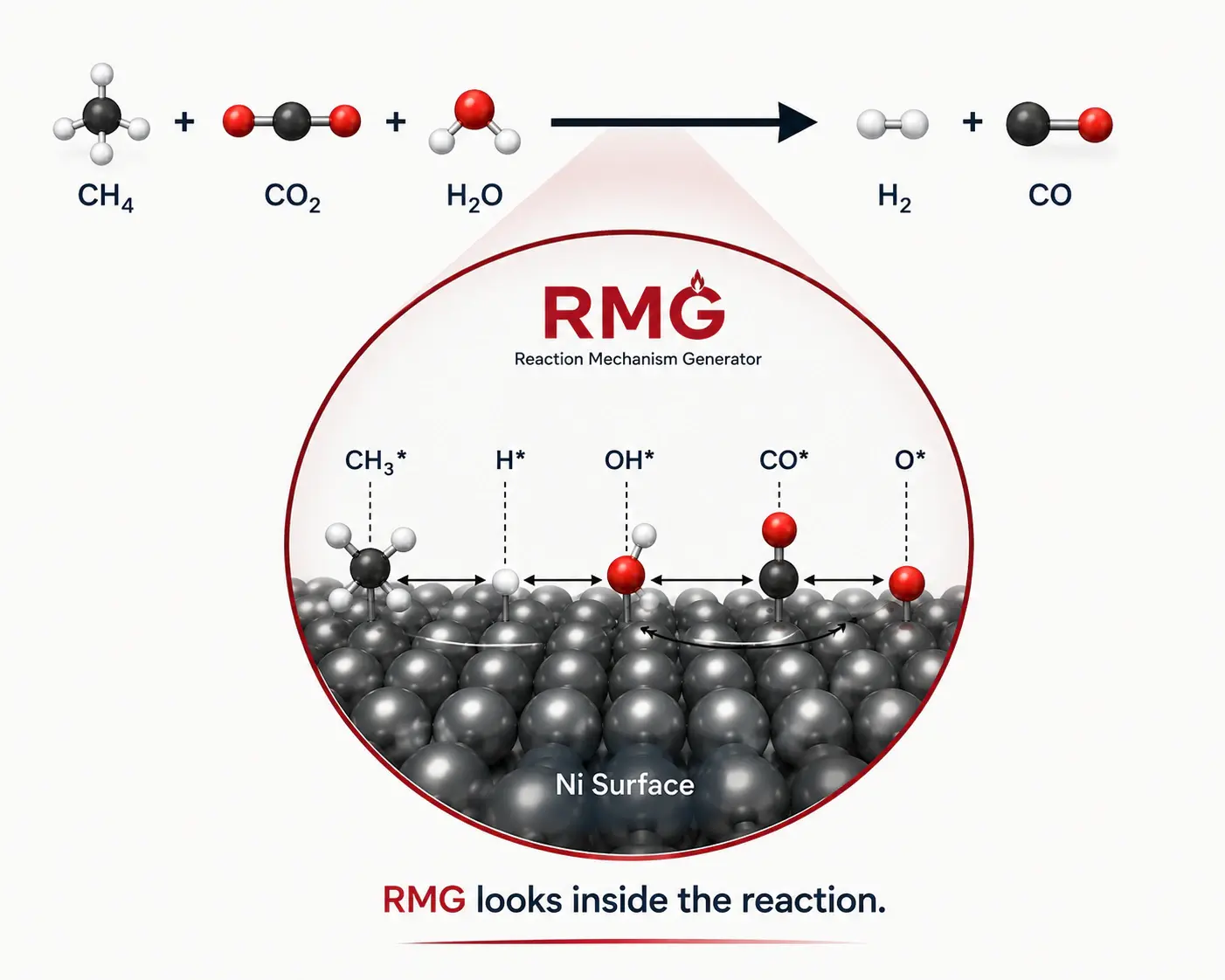
The purpose of this exercise was not to prove that a detailed mechanism is always better than a simpler reactor model. It was simply to look one level deeper. Our normal reactor model sees the overall change from reactants to products. RMG begins to describe the small events that may create that change. This difference becomes much easier to understand if we follow just one molecule.
Follow One Methane Molecule
Methane gives us a simple way to see how surface chemistry works. A methane molecule (CH₄) can reach an open site on the nickel surface and begin to lose hydrogen. After losing one hydrogen, it may become CH₃*. After losing another, it may become CH₂*, then CH, and eventually surface carbon C. The small star is not complicated; it simply tells us that the species is sitting on the catalyst surface. Instead of imagining methane changing into the final products in one jump, we can now picture it changing little by little. Each step removes or rearranges atoms, and each new surface species can react with something else nearby. Water and carbon dioxide are going through their own changes at the same time, so the full reaction is much richer than the single overall equation suggests. This step-by-step view is one of the most useful ideas behind a detailed reaction mechanism because it turns a black box into a chemical story.
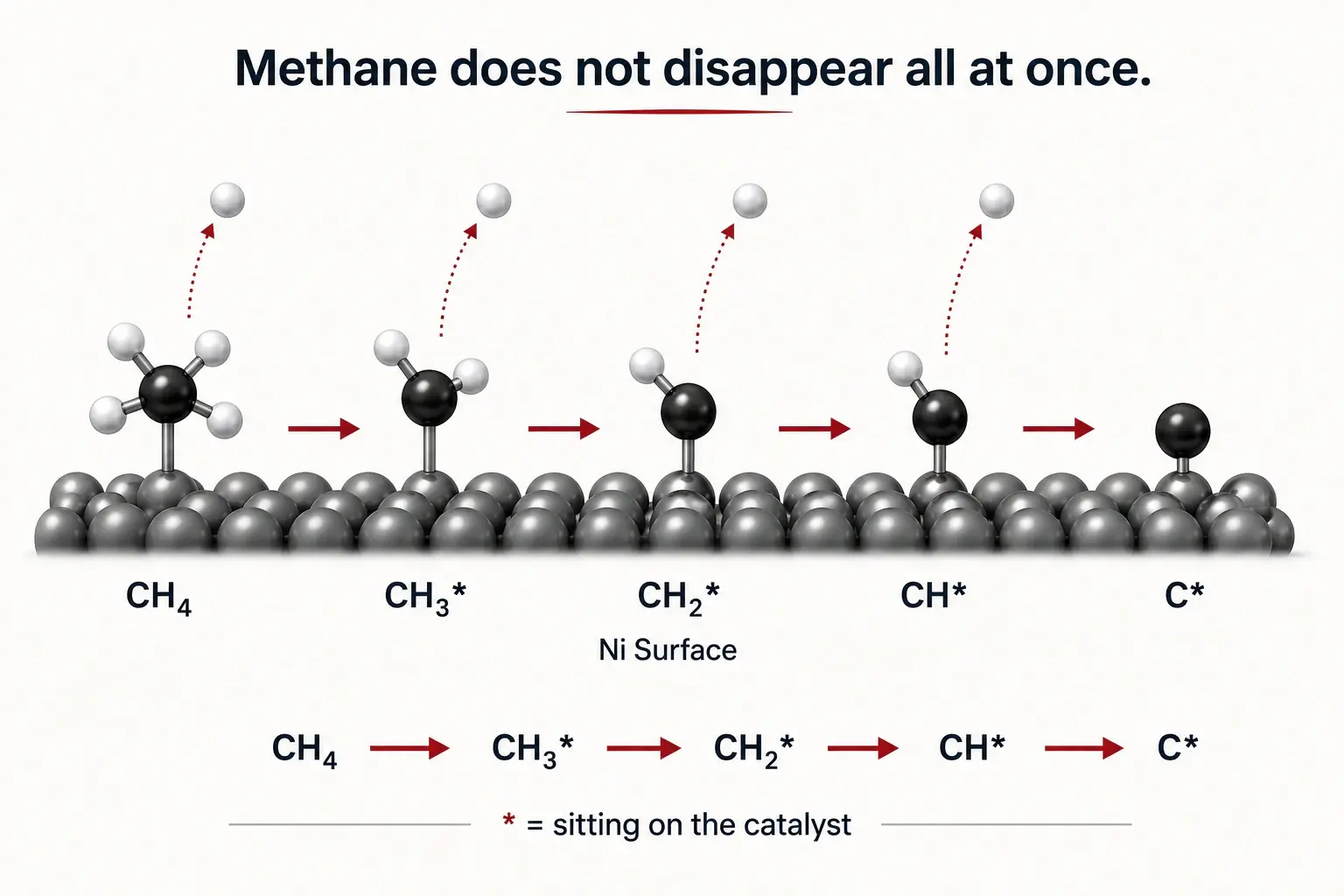
This pathway is also important because it connects directly to one of the biggest practical concerns in reforming: carbon. Before getting there, however, it helps to widen the picture again. Methane is only one visitor on a very busy surface.
The Catalyst Surface Is a Busy Place
When we generated the nickel mechanism with RMG, the surface did not contain only methane fragments. It also included free catalyst sites and adsorbed hydrogen, oxygen, OH, CO, CO₂, carbon, and several (CHx) species. This is important because all of these species can share the same surface and compete for places to sit. A free site on a catalyst is simply an open location where another molecule or fragment may attach. If many sites are occupied, another molecule may have difficulty finding a place to react. If oxygen is present on the surface, it may react differently than hydrogen or carbon. If CO sits strongly on the surface, it may change what other molecules can do nearby. The catalyst therefore starts to look less like an empty metal surface and more like a crowded workplace where many small chemical events are happening at the same time. RMG also showed that some reactions came from an established nickel reforming library, while many others were generated or estimated through surface reaction families. The important result for us was not the total number of reactions. It was that the overall reforming chemistry opened into a much more physical picture of what may be happening directly on nickel.
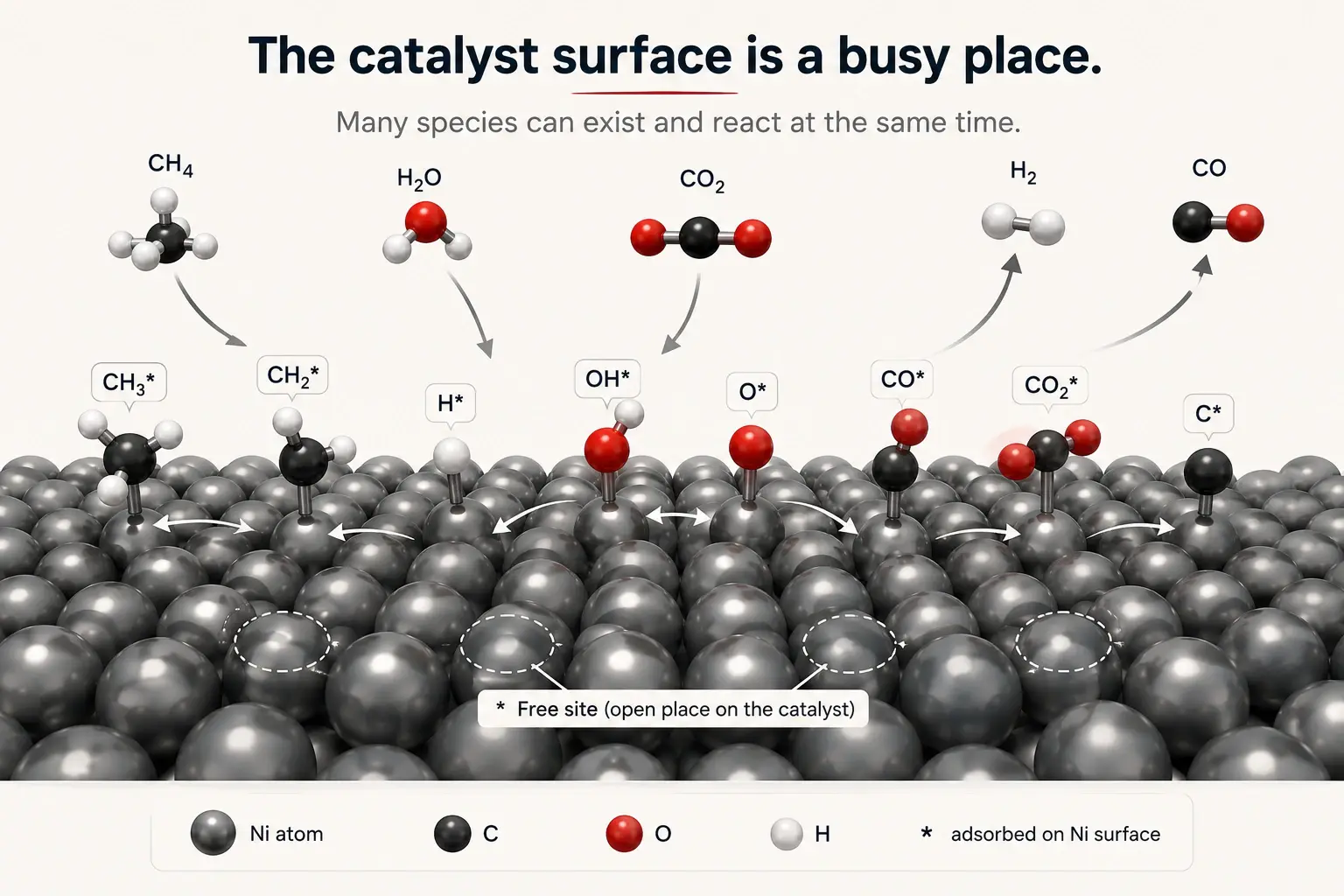
This surface picture also helps us understand why changing the feed can change much more than the overall reaction balance. Adding more steam, for example, does not only change the amount of water in the reactor. It can also change which hydrogen- and oxygen-containing species are present on the catalyst. The same is true for carbon dioxide. Once we think at the surface level, the feed composition begins to change the whole chemical environment around each active site.
Carbon Has Two Possible Futures
Carbon formation is a good example of why looking at surface chemistry can be useful. Nickel is widely used in reforming, but carbon can build up on the catalyst under some operating conditions. If enough carbon stays on the surface, it can cover useful sites and slowly reduce catalyst performance. The methane pathway already gives us one way to see where that carbon may come from because methane can lose hydrogen step by step until C* remains on the nickel. But forming carbon is only half of the story. The same surface may also contain oxygen- and OH-containing species produced through the chemistry of steam and carbon dioxide. Those species can take part in reactions that move surface carbon back toward carbon monoxide and other gas-phase products. This means one carbon atom on nickel can have two very different futures. It may remain on the surface and become part of a growing carbon layer, or it may react with oxygen-containing species and leave. That simple competition helps explain why steam level, carbon dioxide level, and temperature can strongly influence reforming behavior.
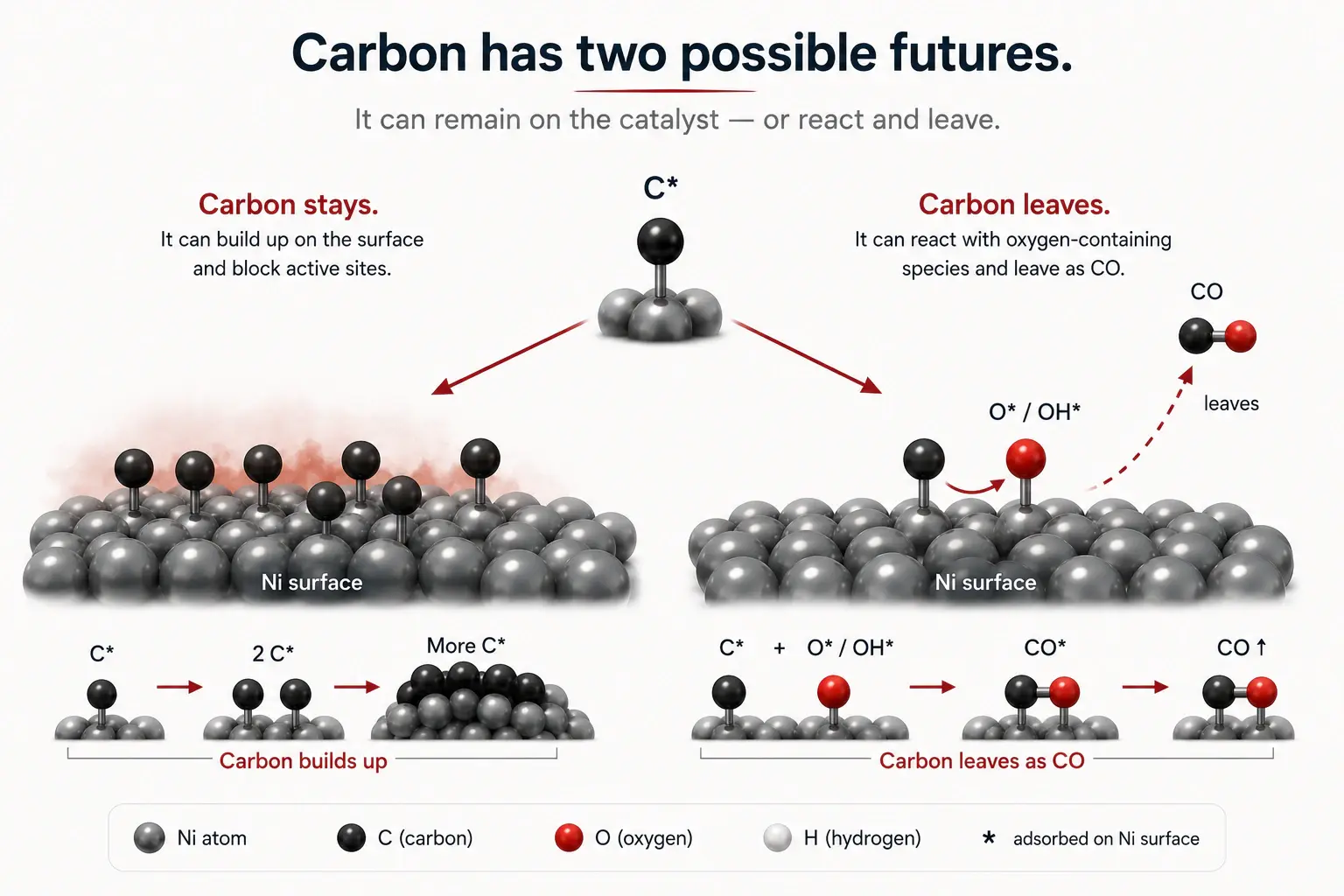
RMG does not automatically solve the full catalyst-deactivation problem for us. A real catalyst contains different surface shapes, defects, pores, particle sizes, and many other details that are not captured by one simple surface model. But the mechanism gives us a clearer way to think about the problem. Instead of adding carbon only as an extra equation at the end of a reactor model, we can see how it may appear naturally as part of the chemistry itself.
Same Reactor, Different Questions
At this point it would be easy to think that a detailed RMG mechanism must be better than a traditional kinetic model because it contains more reactions. That would be the wrong conclusion. Traditional reactor kinetics are extremely valuable, especially when they were developed from careful experiments on real catalysts. A well-tested overall rate equation may predict reactor behavior very well while using only a small number of reactions. It is fast, practical, and often exactly what an engineering study needs. RMG looks at the problem from another direction. It tries to build the smaller reaction steps that may exist underneath the overall behavior, but some of those steps may be based on estimated rates or chemical rules when direct experimental data are not available. More detail therefore does not automatically mean more accuracy. The two approaches simply answer different questions. A global kinetic model is mainly asking, “How fast does the overall reaction happen?” RMG is also asking, “What smaller chemical steps might be producing that reaction?” Both questions can be useful, and the right choice depends on what we are trying to understand.
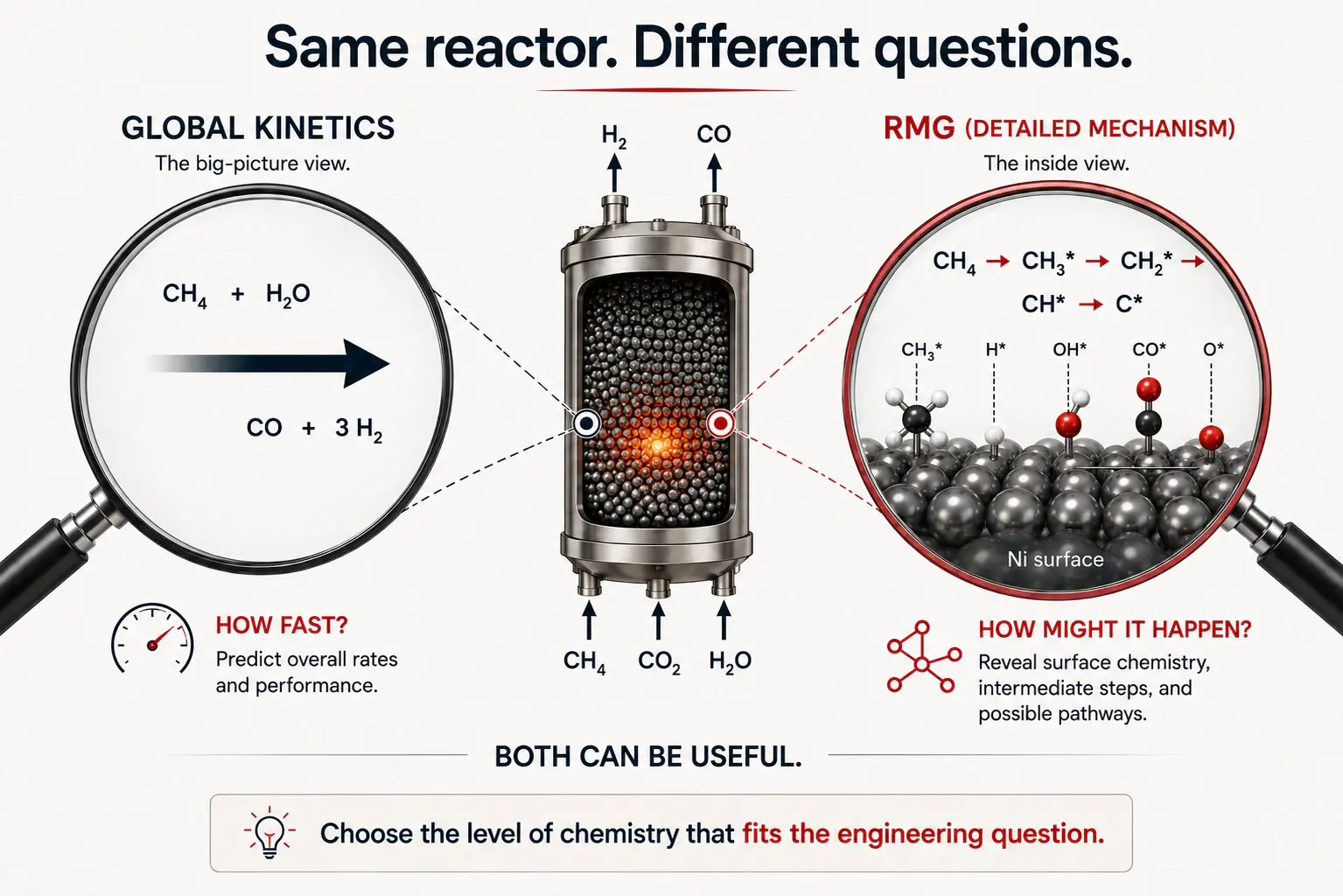
This is an important engineering point because models should not become complicated simply because more complexity is available. Sometimes the simple model is the better model. Sometimes a problem with catalyst behavior, unusual products, carbon formation, or changing feed composition may justify looking deeper. The useful skill is knowing which level of chemistry matches the question being asked.
From Molecules to Engineering Decisions
This is where RMG becomes most interesting to us at M² Engineering. Reaction chemistry by itself is only the beginning of a reactor problem. Once the mechanism exists, it can be connected to reactor calculations where temperature, pressure, flow, heat transfer, and catalyst loading determine what actually happens at an engineering scale. In our test, the generated mechanism could be exported into a format that can be used with Cantera and Python, which creates a practical link between surface chemistry and reactor modeling. From there, the same type of workflow can eventually move toward conversion, syngas composition, temperature profiles, operating limits, and optimization. The path is therefore not simply RMG → more reactions. The useful path is molecules → catalyst → reactor → prediction. RMG helps with the chemistry part, while reactor engineering determines how that chemistry behaves inside a real system. This also leaves room for faster reduced-order models and Neural Operators when large numbers of reactor calculations are required. The goal is not to make every model as complicated as possible. The goal is to understand enough physics and chemistry to make better engineering decisions.
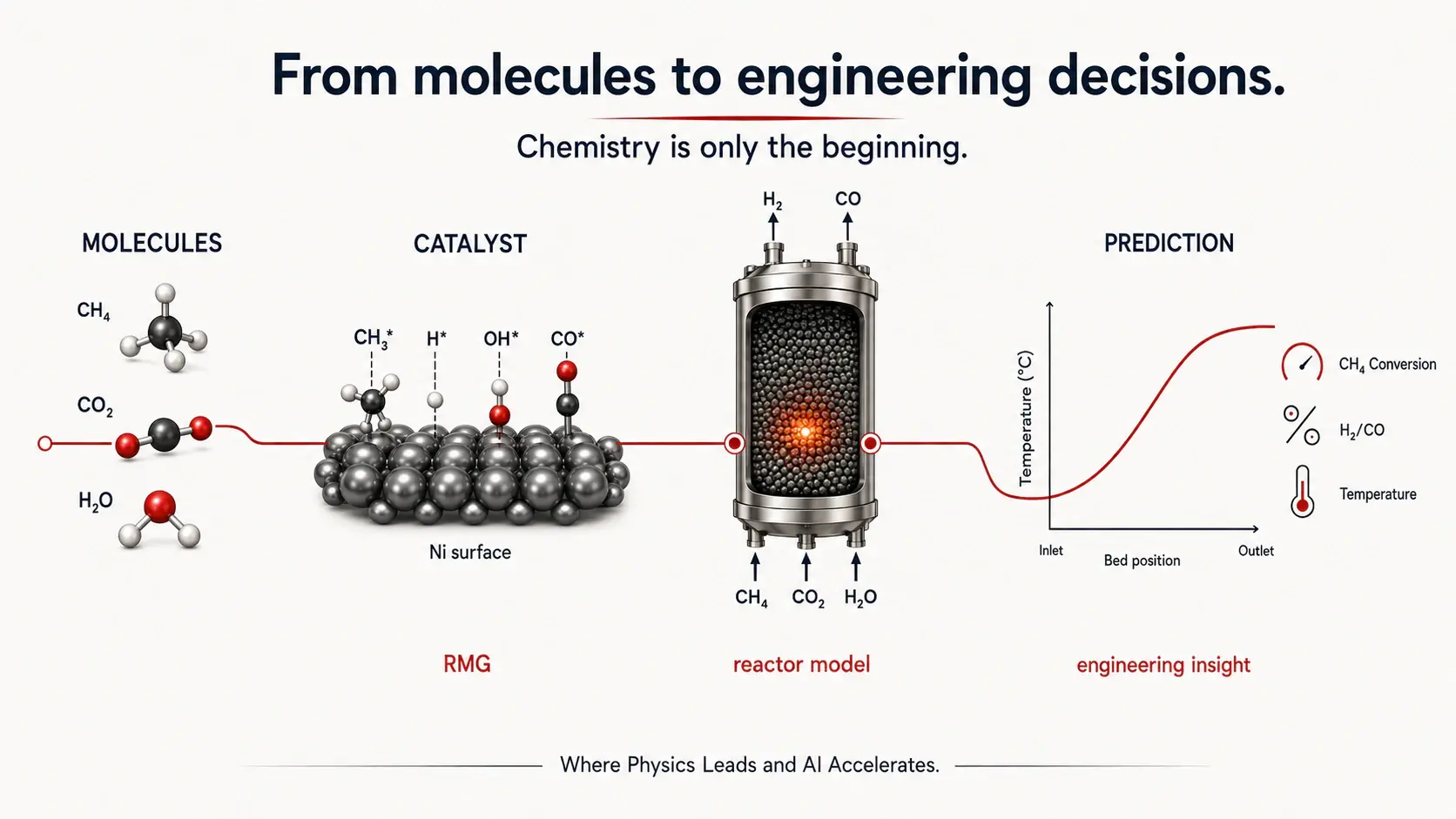
So, can RMG show what really happens on a catalyst? It can help us see much more of the possible chemical story, but it is not a camera looking at a real catalyst surface. It gives us a map of possible reactions and intermediate species, and that map can help us understand what may be happening between the molecules entering a reactor and the products leaving it. For our biogas bi-reforming case, that was enough to open the black box and see the problem differently. Sometimes a few well-tested overall reactions are all we need. Sometimes the engineering question asks us to look one level deeper. RMG gives us a way to do that, and that is where we see its real value.
RMG is an open-source project that grew from the work of Prof. William H. Green and his group at MIT and has benefited from contributions from researchers and developers across the wider RMG community. We gratefully acknowledge the people who have built and openly shared this capability with the reaction-engineering community.
M² Engineering
At M² Engineering, we use tools like RMG when the engineering question needs more than a simple overall reaction. Our focus is not on adding complexity for its own sake, but on understanding where deeper chemistry can improve reactor design, catalyst understanding, process performance, and technical decision-making.
We connect reaction chemistry, catalyst behavior, reactor physics, thermal analysis, process modeling, and computational acceleration into one engineering workflow. That means a problem can be studied from the molecular level all the way to reactor-scale performance, while still keeping the final model practical and focused on the decisions that matter.
For catalytic and thermal-reactive systems, this approach can help reveal where global kinetics are sufficient and where a more detailed reaction mechanism may add real value. Whether the goal is understanding carbon formation, improving syngas production, comparing operating conditions, or building faster predictive models, we choose the level of physics and chemistry that fits the problem.
M² Engineering - Where Physics Leads and AI Accelerates.