Most engineers would assume that a 900°C ammonia cracking reactor should have little difficulty achieving high conversion.
After all, higher temperatures accelerate reaction rates, reduce reactor size, and are widely used throughout the chemical process industry.
We thought so too.
However, when we examined the thermal behavior of an ammonia cracking reactor, the results told a very different story.
What began as a straightforward investigation into reactor sizing quickly evolved into a much more interesting question:
Is ammonia cracking really a temperature problem, or is it fundamentally a thermal management problem?
Process Configuration
Ammonia is attracting increasing attention as a hydrogen carrier because it can be transported, stored, and distributed using infrastructure that already exists at industrial scale. To recover hydrogen, ammonia must be decomposed into hydrogen and nitrogen through a strongly endothermic reaction.
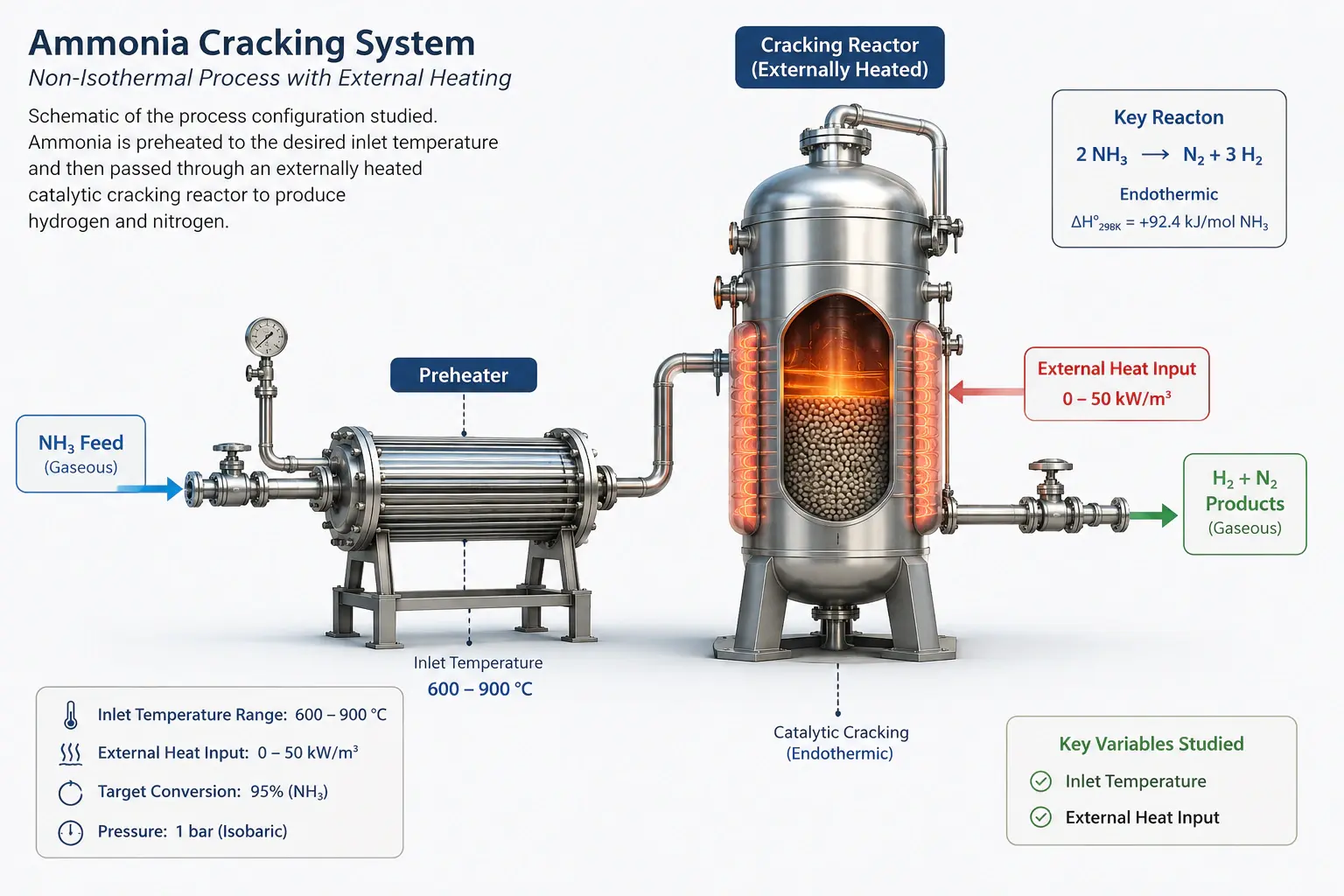
The process configuration investigated in this study consists of a feed preheater followed by an externally heated ammonia cracking reactor operating at atmospheric pressure.
Illustration 1 – Ammonia Cracking Process Configuration
Study Basis
The analysis was performed using an idealized plug flow reactor to isolate the thermal behavior governing ammonia cracking.
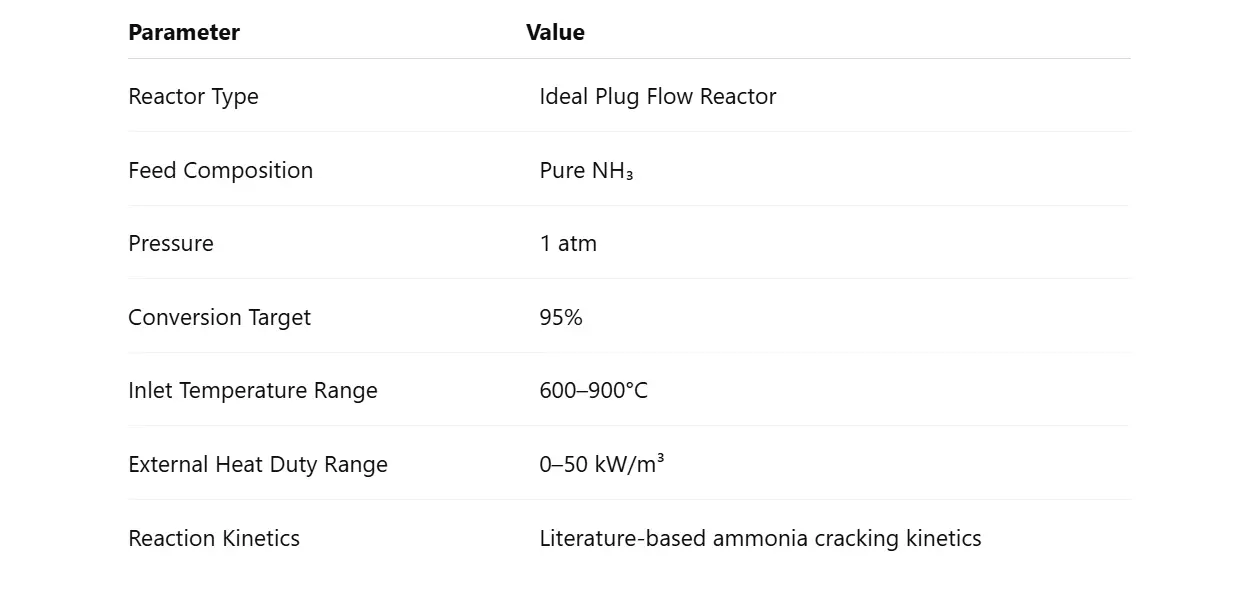
The objective was not to reproduce the performance of a specific commercial reactor, but rather to understand the thermal tradeoffs that govern reactor design under idealized conditions.
Higher Temperatures Dramatically Reduce Reactor Size
From a reaction engineering perspective, increasing temperature appears to be an obvious solution.
Higher temperatures accelerate reaction rates, reduce the residence time required for conversion, and therefore reduce reactor size.
To quantify this effect, the reactor volume required to achieve 95% ammonia conversion was evaluated across the investigated temperature range.
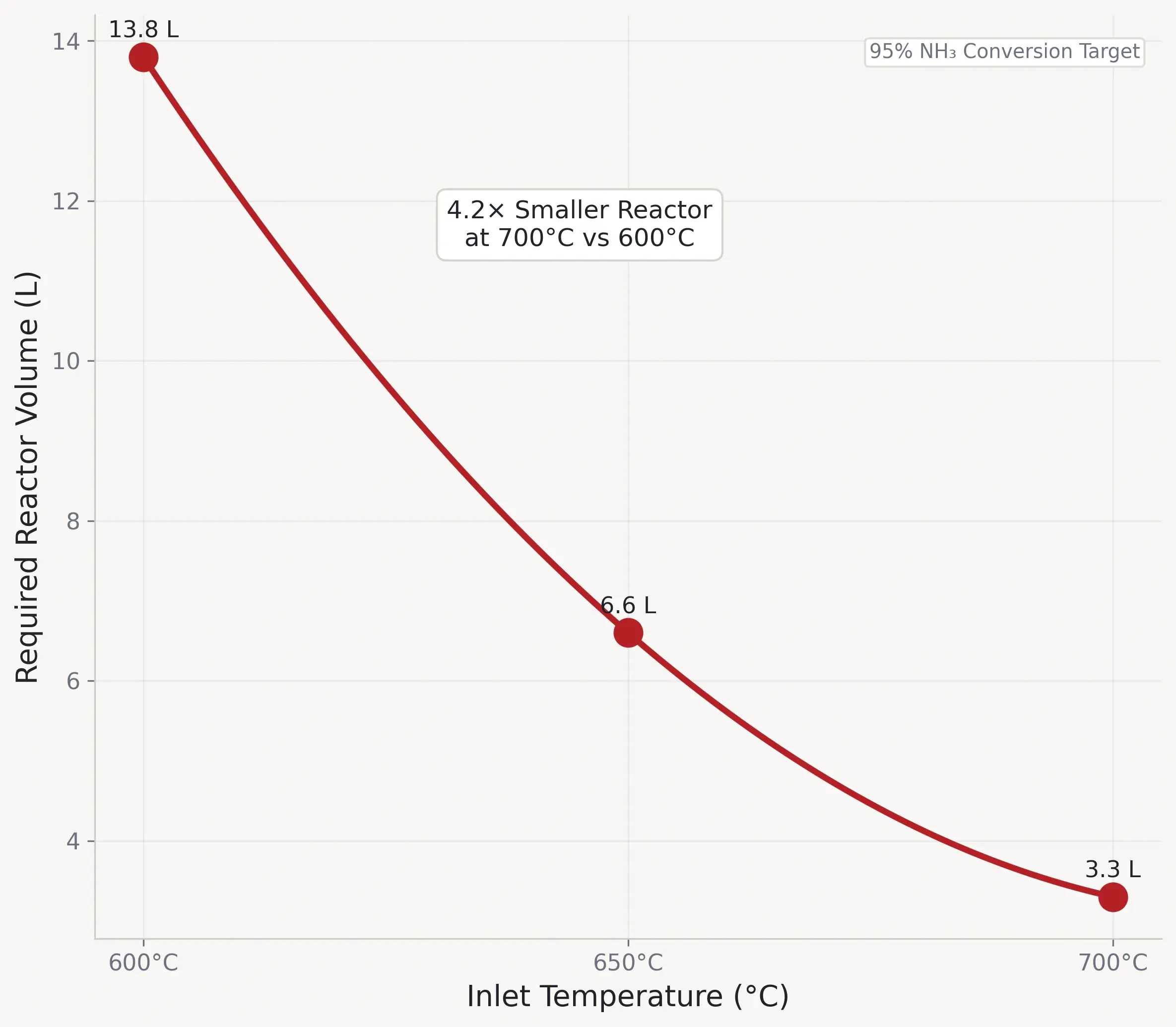
The answer was both expected and surprising.
As anticipated, increasing temperature significantly reduced reactor volume. Between 600°C and 700°C, the required reactor volume decreased from approximately 13.8 L to 3.3 L, corresponding to more than a fourfold reduction in reactor size.
For reactor designers, this translates directly into smaller equipment, reduced footprint, and potentially lower capital cost.
At this stage, the conclusion appears straightforward:
Higher temperatures should solve the problem.
But that conclusion turns out to be incomplete.
The Result That Changed the Story
The next step was to examine reactor performance under adiabatic conditions.
In other words:
What happens if the reactor receives no external heating once the reaction begins?
The answer was not surprising, yet the implications were.
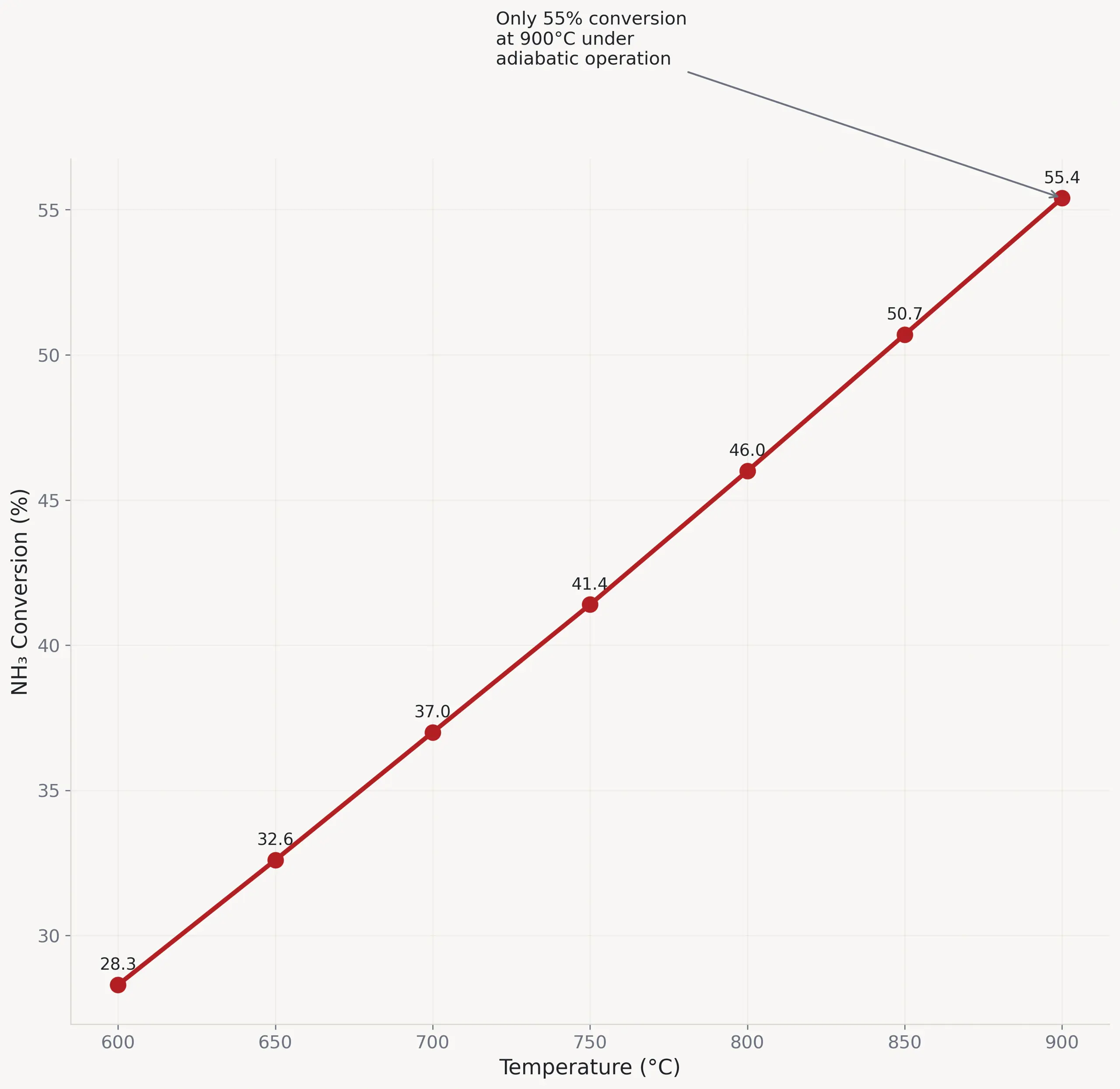
As expected, conversion increased with temperature.
However, even at an inlet temperature of 900°C, the reactor achieved only about 55% ammonia conversion.
Across the investigated temperature range, conversion remained between approximately 28% and 55%.
That means nearly half of the ammonia remained unconverted even at temperatures many engineers would consider extremely high.
This observation fundamentally changes how the problem should be viewed.
If temperature alone cannot achieve high conversion, then something else is limiting reactor performance.
Where Did the Energy Go?
The answer lies in the thermodynamics of ammonia cracking.
Ammonia decomposition is strongly endothermic. As the reaction proceeds, thermal energy is continuously consumed from the reacting gas mixture.
Without a mechanism to replace that energy, the reactor cools as conversion increases.
As temperature falls:
- Reaction rates decrease
- Conversion slows
- Reactor performance deteriorates
The reactor effectively begins to work against itself.
Once viewed through this lens, ammonia cracking no longer appears to be purely a reaction-engineering problem.
It becomes a thermal-management problem.
This naturally leads to the next question:
How much external heating is actually required to achieve high conversion?
The Hidden Requirement
To answer this question, the external volumetric heat input required to achieve 95% conversion was evaluated across the investigated temperature range.
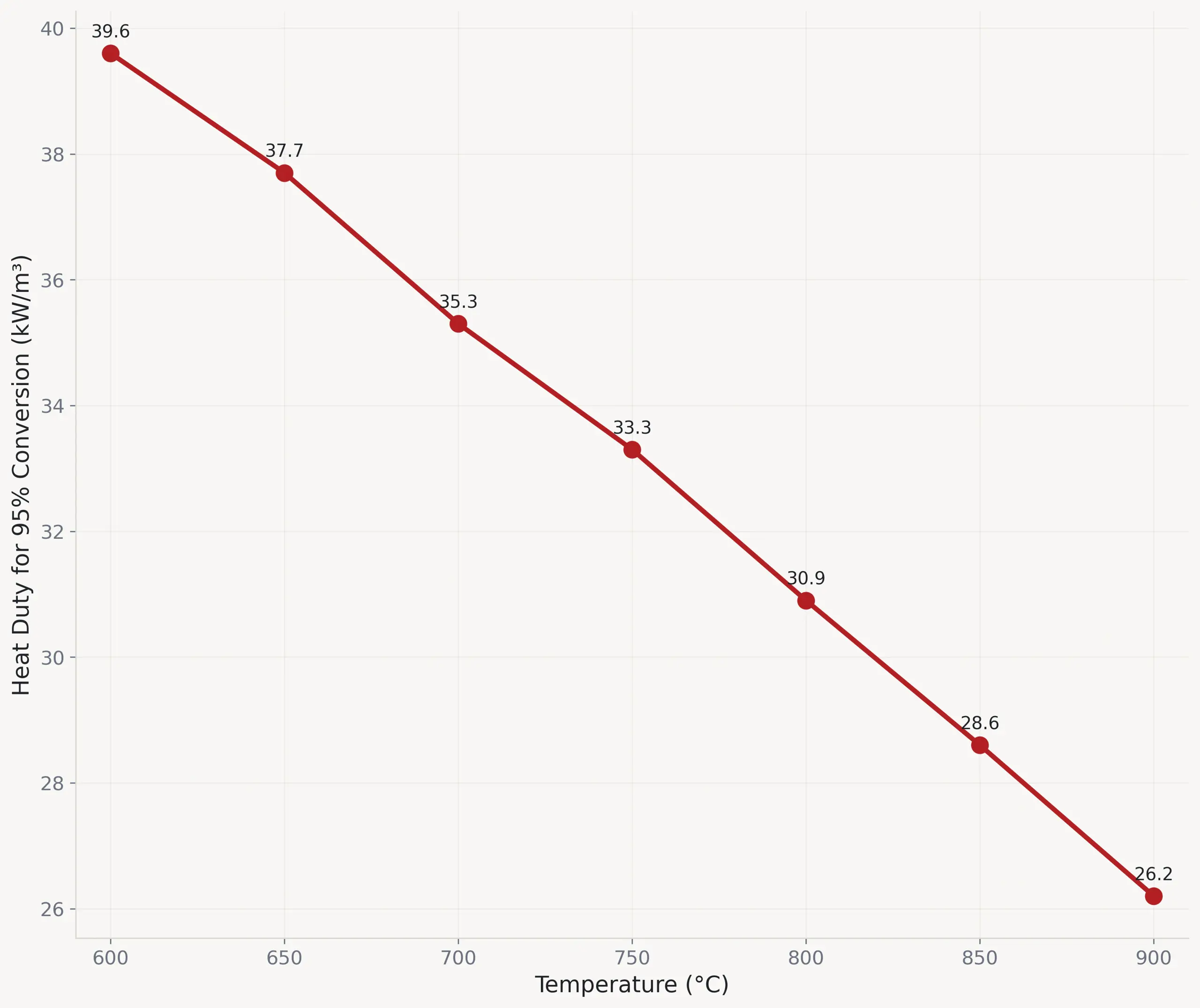
The results show that increasing inlet temperature reduces the amount of heat that must be supplied within the reactor.
However, the reduction is far less dramatic than many engineers might expect.
Even at 900°C, approximately 26 kW/m³ of distributed reactor heating is still required to achieve 95% conversion.
In other words, high operating temperatures do not eliminate the need for reactor heating.
They simply reduce it.
This finding reinforces an important engineering reality:
The reactor still requires a continuous supply of thermal energy to sustain high conversion.
The Real Design Tradeoff
At this stage, the design question changes.
The challenge is no longer determining how hot the reactor should operate.
The challenge is determining where thermal energy should be supplied within the process.
To investigate this tradeoff, two energy requirements were evaluated as a function of inlet temperature:
- Energy required to preheat the ammonia feed.
- Energy required within the reactor to achieve 95% conversion.
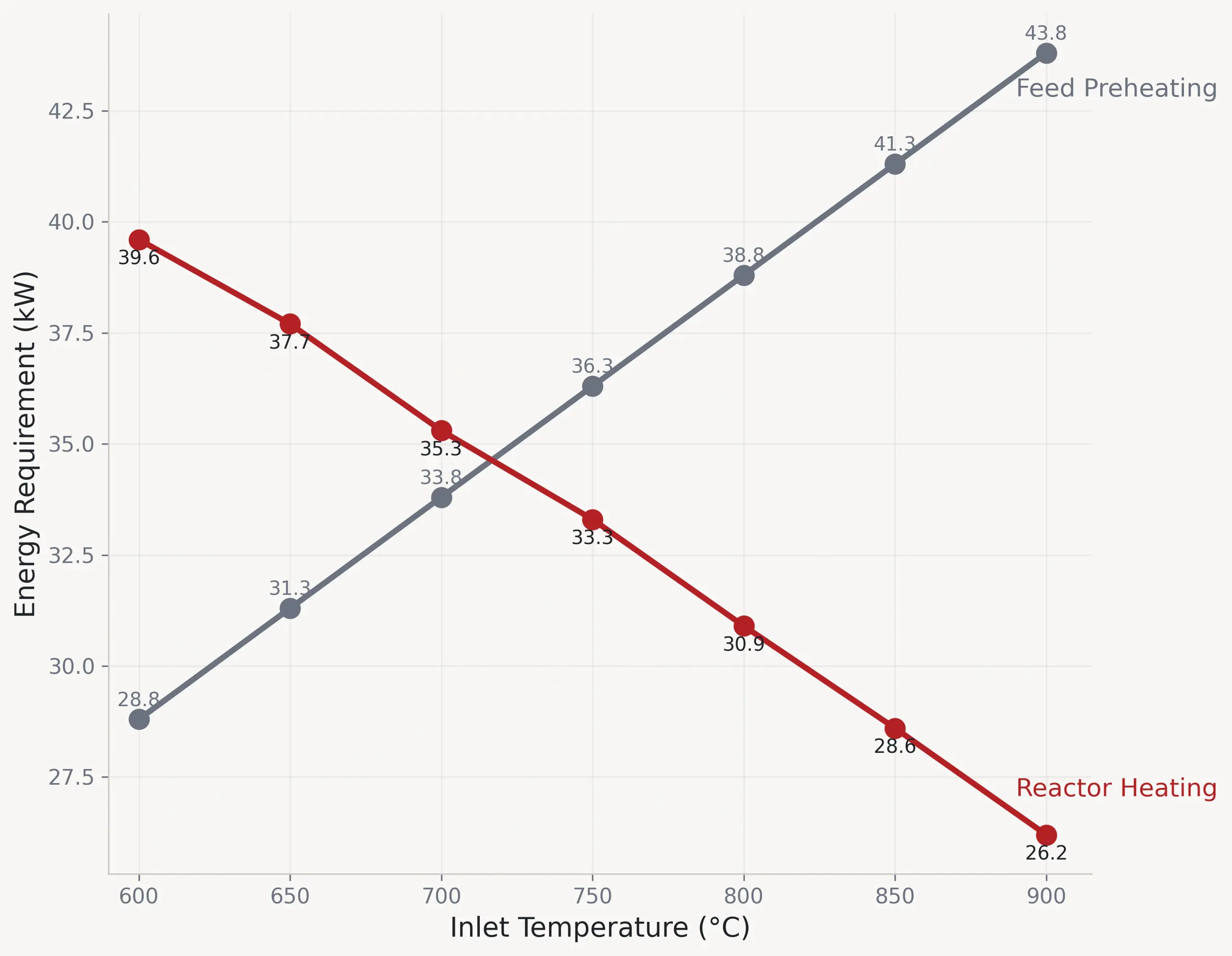
The results reveal two opposing trends.
As inlet temperature increases:
- Feed preheating requirements increase.
- Reactor heat duty requirements decrease.
In other words, operating at a higher inlet temperature reduces the thermal burden on the reactor but shifts that burden to the feed preheater.
Operating at a lower inlet temperature has the opposite effect.
The two energy requirements become comparable near approximately 725°C.
This temperature should not be interpreted as an optimum operating point. A true optimum would require a detailed techno-economic assessment incorporating utility costs, equipment costs, heat recovery opportunities, catalyst performance, materials limitations, and plant-specific operating conditions.
However, the crossover does identify a balanced thermal operating region where neither feed preheating nor reactor heating overwhelmingly dominates the thermal design.
Key Takeaway
At first glance, ammonia cracking appears to be a temperature problem.
Higher temperatures reduce reactor size and accelerate reaction rates, suggesting that simply operating hotter should improve performance.
Our results tell a different story.
Even at 900°C, adiabatic operation achieves only about 55% conversion. The limiting factor is not reaction kinetics alone, but the reactor’s ability to continuously supply energy to an endothermic process.
Once this perspective is adopted, the design question changes entirely.
The challenge is no longer determining how hot the reactor should operate.
The challenge is determining where thermal energy should be supplied within the process.
That distinction governs conversion, reactor size, energy consumption, and ultimately the practical design of ammonia cracking systems.
In that sense, ammonia cracking is not fundamentally a temperature problem.
It is a thermal management problem.
Limitations
Several practical considerations were intentionally excluded from the present analysis, including pressure drop, catalyst deactivation, reactor internals, heat exchanger design, and heat recovery integration.
Consequently, the results should be interpreted as an idealized thermal design study intended to reveal governing trends rather than predict the performance of a specific commercial reactor.