
Abstract
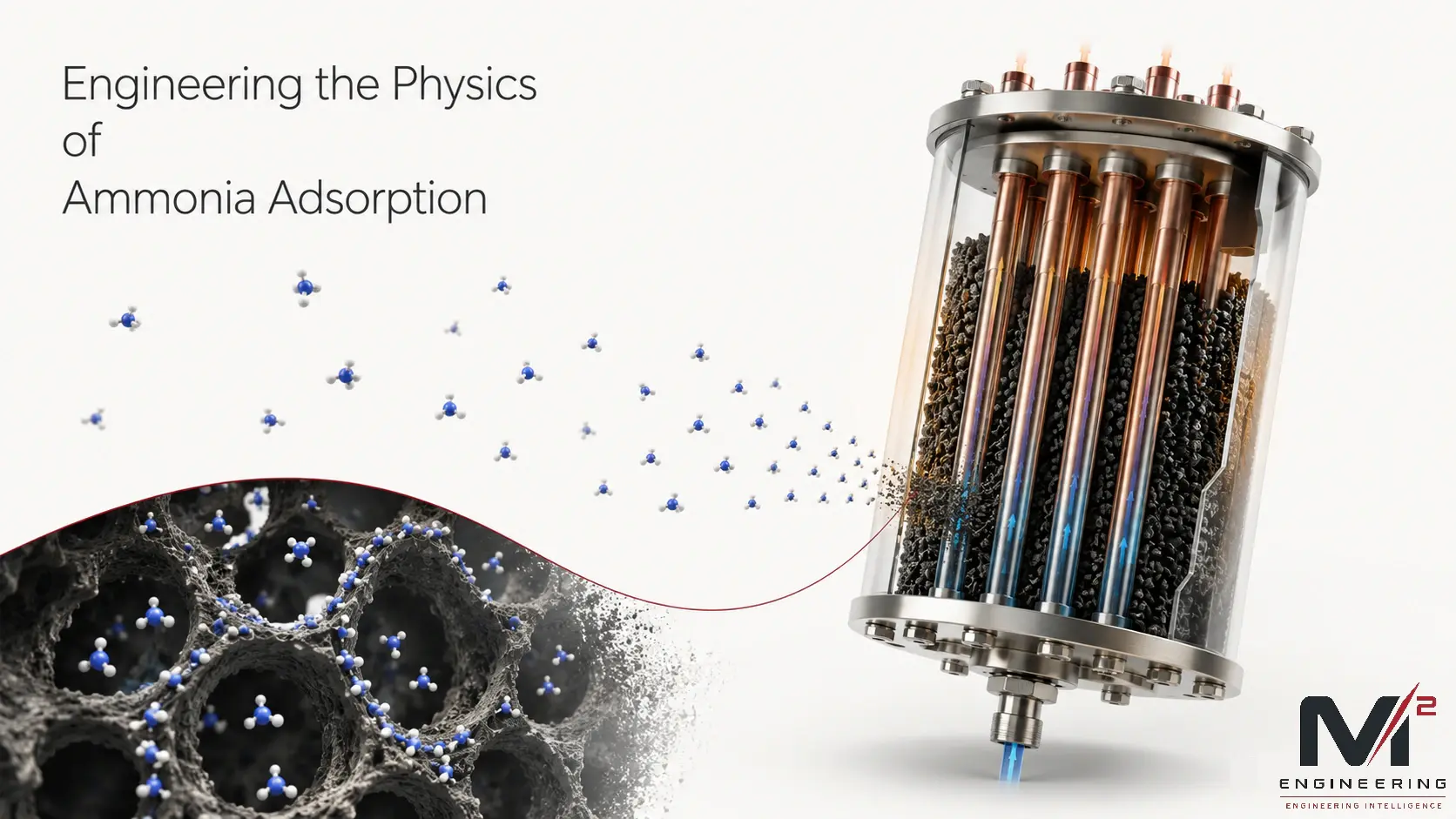
Ammonia adsorption on activated carbon is a promising technology for thermal energy storage, heat pumping, and refrigeration thanks to its high energy density and environmentally friendly working fluid. Accurately predicting the transient behavior, however, requires simultaneously solving coupled heat transfer, species transport, adsorption kinetics, and thermodynamic equilibrium inside porous media. In this work, we developed a three-dimensional transient model of an activated carbon adsorption reactor to explore the dynamic evolution of ammonia adsorption. The model integrates heat transfer in porous media, ammonia transport, and linear driving force (LDF) kinetics to reveal the spatial and temporal distributions of adsorbed ammonia loading, gas-phase concentration, and temperature. The simulations highlight the strong coupling between heat release and adsorption: localized temperature rises temporarily suppress further uptake until the reactor gradually approaches thermodynamic equilibrium. These insights into adsorption front propagation, thermal management, and reactor utilization underscore the critical importance of fully coupled physics modeling for designing high-performance adsorption systems.
Engineering Begins with Physics
Computational engineering has become an indispensable tool for tackling complex thermal and energy systems. Thanks to major advances in numerical methods and computing power, we can now simulate coupled heat transfer, fluid flow, chemical reactions, and species transport with impressive accuracy. Still, the true predictive power of any model has far less to do with the sophistication of the solver and much more to do with the physical correctness of the governing equations themselves.
Every solid engineering model starts with one fundamental question: What physical quantities actually need to be conserved?
In an adsorption heat pump, that question leads straight to the conservation of ammonia. As the system runs, ammonia moves continuously between the gas phase and the internal surfaces of the activated carbon, releasing heat in the process. These phenomena are so tightly intertwined that mass transport, thermodynamics, reaction kinetics, and heat transfer cannot be treated as separate issues. The reactor becomes a classic example of a true coupled physics system.
In this article, I show how to build a computational model by starting with those core conservation laws and carefully deriving the governing equations for the adsorption process. We begin with conservation of ammonia, then develop the equations for species transport, adsorption, and heat generation before bringing in the constitutive models for kinetics and equilibrium. The end result is a physically consistent framework that can reliably predict the transient behavior of an ammonia adsorption heat pump.
While this case study focuses on adsorption cooling, the same approach works across many other applications. You can apply it to hydrogen production, thermal energy storage, battery thermal management, semiconductor cooling, and any number of coupled physics problems where good predictions depend on a solid grounding in the underlying physics.
From Conservation Laws to Governing Equations
The operation of an adsorption heat pump is governed by a simple physical principle: ammonia continuously transfers between the gas phase and the activated carbon, but the total amount of ammonia within the reactor remains constant. This conservation law forms the foundation of the computational model.
The total ammonia inventory can be expressed as
where Mgas represents ammonia in the gas phase and Mads is the amount adsorbed within the activated carbon.
For a closed adsorption bed,
This relationship ensures that every molecule of ammonia removed from the gas phase is accounted for within the adsorbent. Rather than introducing independent reaction terms, this conservation statement becomes the starting point for deriving the governing equations.
To describe the local transport of ammonia, the conservation law is applied to an infinitesimal control volume within the porous activated-carbon bed. Since gaseous ammonia occupies only the pore volume, the gas-phase species balance becomes
where c is the gas-phase ammonia concentration, *εb* is the bed porosity, N is the diffusive molar flux, and *RNH3* is the adsorption reaction source. At this point, the transport equation is still incomplete because the adsorption source has not yet been defined. The adsorption kinetics are formulated in terms of the adsorbed loading,
where q is the adsorption loading expressed as kilograms of ammonia adsorbed per kilogram of activated carbon. Since the adsorption rate is expressed per unit mass of adsorbent, while the species equation requires a source term per unit reactor volume, the two are connected through the packed-bed bulk density. The resulting gas-phase reaction source is
The negative sign indicates that ammonia is removed from the gas phase during adsorption. The packed-bed bulk density provides the conversion from adsorption per unit mass of activated carbon to adsorption per unit volume of the porous bed. No additional solid-volume correction is required because the bulk density already represents the amount of adsorbent contained within the packed reactor volume.
The same adsorption process is responsible for heat generation within the reactor. As ammonia molecules adsorb onto the activated carbon, the heat of adsorption is released into the porous bed. The volumetric heat source therefore follows directly from the adsorption rate,
Consequently, the species and energy equations are coupled through a common physical process. The adsorption rate simultaneously governs the removal of ammonia from the gas phase, the accumulation of ammonia within the activated carbon, and the release of adsorption heat. By deriving both source terms directly from the conservation of ammonia, the computational model maintains a physically consistent mass and energy balance throughout the adsorption cycle.
Building the Computational Model
The conservation equations developed in the previous section establish the transport of ammonia and the corresponding heat generation within the adsorption bed. To complete the mathematical model, two constitutive relationships are required. The first describes the adsorption kinetics, while the second determines the equilibrium adsorption capacity.
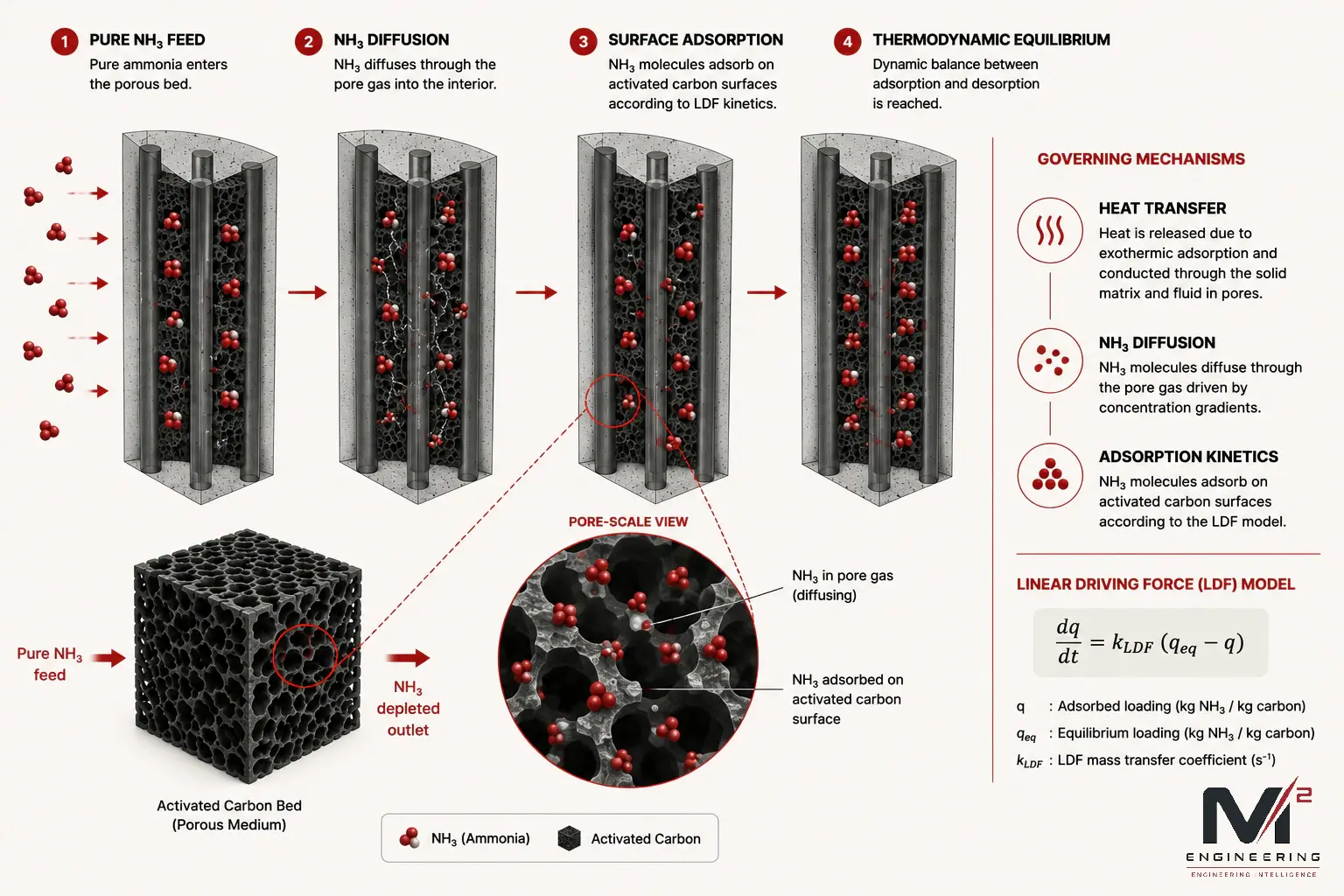
The transient adsorption process is represented using the Linear Driving Force (LDF) model,
where kLDFk is the kinetic coefficient, q is the instantaneous adsorption loading, and qeq is the equilibrium loading. The model assumes that the adsorption rate is proportional to the difference between the current loading and its equilibrium value. As adsorption progresses, this driving force continuously decreases until equilibrium is reached.
The equilibrium loading is evaluated using the Dubinin–Astakhov (DA) isotherm,
where the adsorption potential Aads,
governs the thermodynamic equilibrium between the gas phase and the activated carbon. Unlike conventional pressure-based isotherms, the DA model naturally captures the adsorption behavior of microporous materials over a wide range of operating conditions.
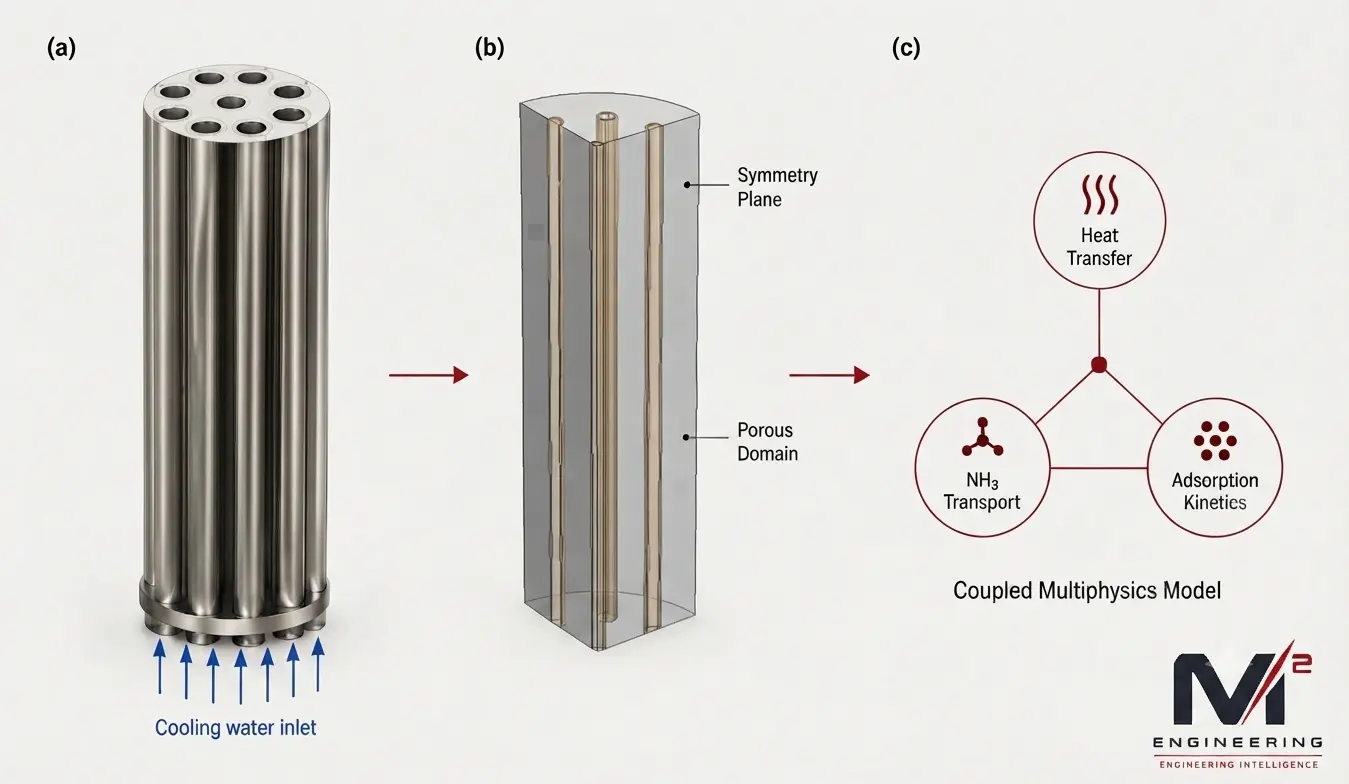
The governing equations and constitutive relationships are applied to a compact adsorption heat pump consisting of a cylindrical vessel packed with activated carbon and cooled internally by copper tubes. During operation, ammonia diffuses through the porous bed, adsorbs onto the activated carbon, and releases heat that is simultaneously removed by the cooling tubes.
Because the governing equations are fully coupled, no physical process evolves independently. Changes in temperature alter the equilibrium loading through the adsorption isotherm. The equilibrium loading determines the adsorption rate through the LDF model. The adsorption rate governs both the removal of ammonia from the gas phase and the release of adsorption heat. The resulting heat generation modifies the temperature field, completing the feedback loop that controls the transient behavior of the reactor. Rather than prescribing the adsorption process, the computational model allows this coupled behavior to emerge naturally from the interaction between conservation laws, adsorption kinetics, and thermodynamic equilibrium.
Key Insight
The governing equations describe what must be conserved, while the constitutive models describe how the material behaves. Together, they form a predictive computational model capable of capturing the coupled evolution of mass transfer, heat transfer, and adsorption.
Engineering Insights from the Transient Response
The value of a transient analysis extends beyond predicting the final operating condition of the reactor. It reveals how the governing physical processes interact as the system evolves toward thermodynamic equilibrium. For adsorption systems, this evolution cannot be understood from a steady-state solution alone because heat transfer, adsorption kinetics, and thermodynamic equilibrium continuously influence one another throughout the adsorption cycle.
Figure 3 illustrates the transient evolution of the adsorption process. At the beginning of the cycle, the activated-carbon bed is close to its initial thermodynamic state. As cooling water extracts heat through the embedded tubes, the local bed temperature decreases, increasing the equilibrium adsorption capacity predicted by the Dubinin–Astakhov isotherm. The activated carbon is therefore no longer in equilibrium with the surrounding ammonia gas, creating the driving force for adsorption.
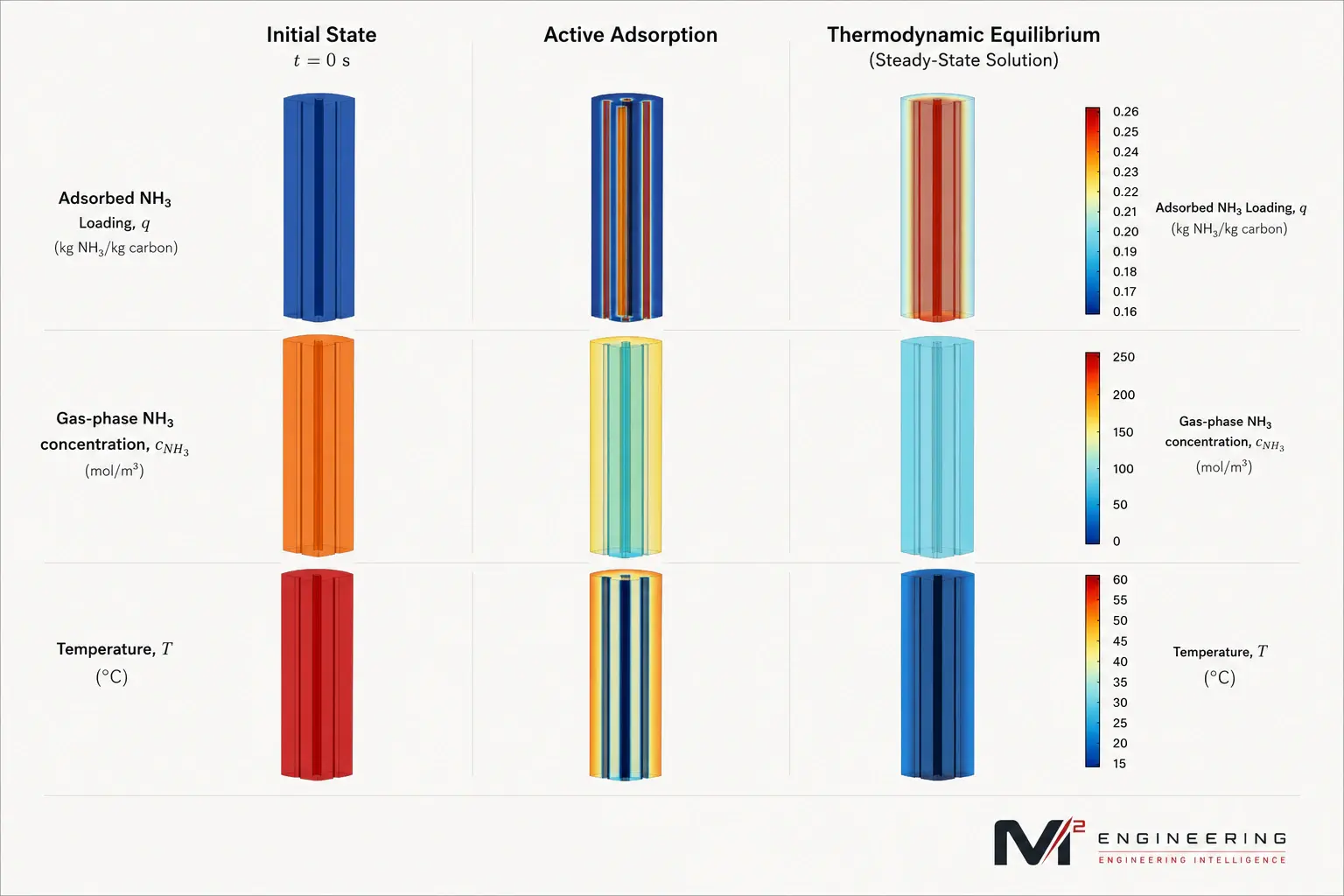
Ammonia begins to diffuse through the porous bed and adsorb onto the internal surface of the activated carbon. As adsorption proceeds, the gas-phase ammonia concentration decreases while the adsorbed loading increases. The transfer of ammonia from the gas phase to the solid phase is governed by the species source term derived directly from the conservation of ammonia, ensuring that the total ammonia inventory remains constant throughout the process.
Unlike purely mass-transfer-limited systems, adsorption is accompanied by the release of heat. The adsorption heat source increases the local bed temperature, reducing the adsorption potential and consequently decreasing the equilibrium loading. This creates a natural feedback mechanism in which heat released during adsorption progressively weakens the driving force responsible for the adsorption process itself.
As the difference between the instantaneous loading and the equilibrium loading becomes smaller, the adsorption rate decreases continuously. Eventually, the reactor reaches a new thermodynamic equilibrium where the adsorption driving force approaches zero, the gas-phase concentration becomes stable, and heat generation ceases.
This behavior is not imposed through numerical constraints or empirical switching functions. It emerges directly from the interaction between the governing conservation equations, adsorption kinetics, and thermodynamic equilibrium.
The transient solution therefore provides more than a visualization of the adsorption process. It demonstrates that the governing equations collectively describe the coupled physics governing the reactor, from the onset of cooling to the establishment of thermodynamic equilibrium.
Engineering Discussion
The adsorption heat pump in this work is really just a practical example of a broader engineering principle: reliable computational models are built by first identifying the key conservation laws and then carefully deriving the equations needed to satisfy them. Numerical solution comes at the end of that process, never at the beginning.
In this study, conservation of ammonia served as the foundation. It led directly to the gas-phase species transport equation and the associated adsorption source term. That same adsorption rate was then used to derive the volumetric heat source, keeping both mass and energy conservation consistent across the entire model. From there, we added constitutive relationships for adsorption kinetics and thermodynamic equilibrium to complete the framework, allowing us to accurately predict the reactor’s transient behavior.
While we demonstrated the approach with an ammonia adsorption heat pump, the methodology applies to a wide variety of systems involving coupled transport phenomena. Whether you’re working on hydrogen production, thermal energy storage, battery thermal management, semiconductor cooling, or chemical process intensification, the fundamentals remain the same: establish the governing conservation laws, choose suitable constitutive models, and solve the resulting coupled equations.
As computational engineering continues to advance, tools like reduced-order models, neural operators, and artificial intelligence will speed up analysis and design even further. But their effectiveness will always depend on the quality of the underlying physical models they build upon. Predictive engineering starts with physically consistent governing equations. The advanced tools just make those models run faster and become more accessible.
At the end of the day, reliable engineering models are built on physics first and solved numerically second. That principle doesn’t change, no matter how complex the software or how sophisticated the tools become.