Introduction
Thermal management remains one of the most challenging engineering problems in semiconductor manufacturing. As plasma processing systems continue to increase in power density, maintaining wafer temperature uniformity becomes increasingly difficult. Localized overheating can influence process repeatability, wafer stress, film properties, etch rates, and ultimately manufacturing yield.
Conventional cooling approaches often struggle to simultaneously achieve three competing objectives:
- Uniform heat removal across the wafer surface
- Low hydraulic pressure losses
- Manufacturable cooling plate geometries
To address these challenges, M² Engineering investigated a radial-manifold liquid-cooling architecture designed specifically for high-heat-flux semiconductor wafer applications.
The objective was to evaluate whether a centrally fed radial cooling network could effectively redistribute coolant, suppress thermal hotspots, and maintain acceptable hydraulic performance under representative plasma-processing conditions.
Radial-Manifold Cooling Concept
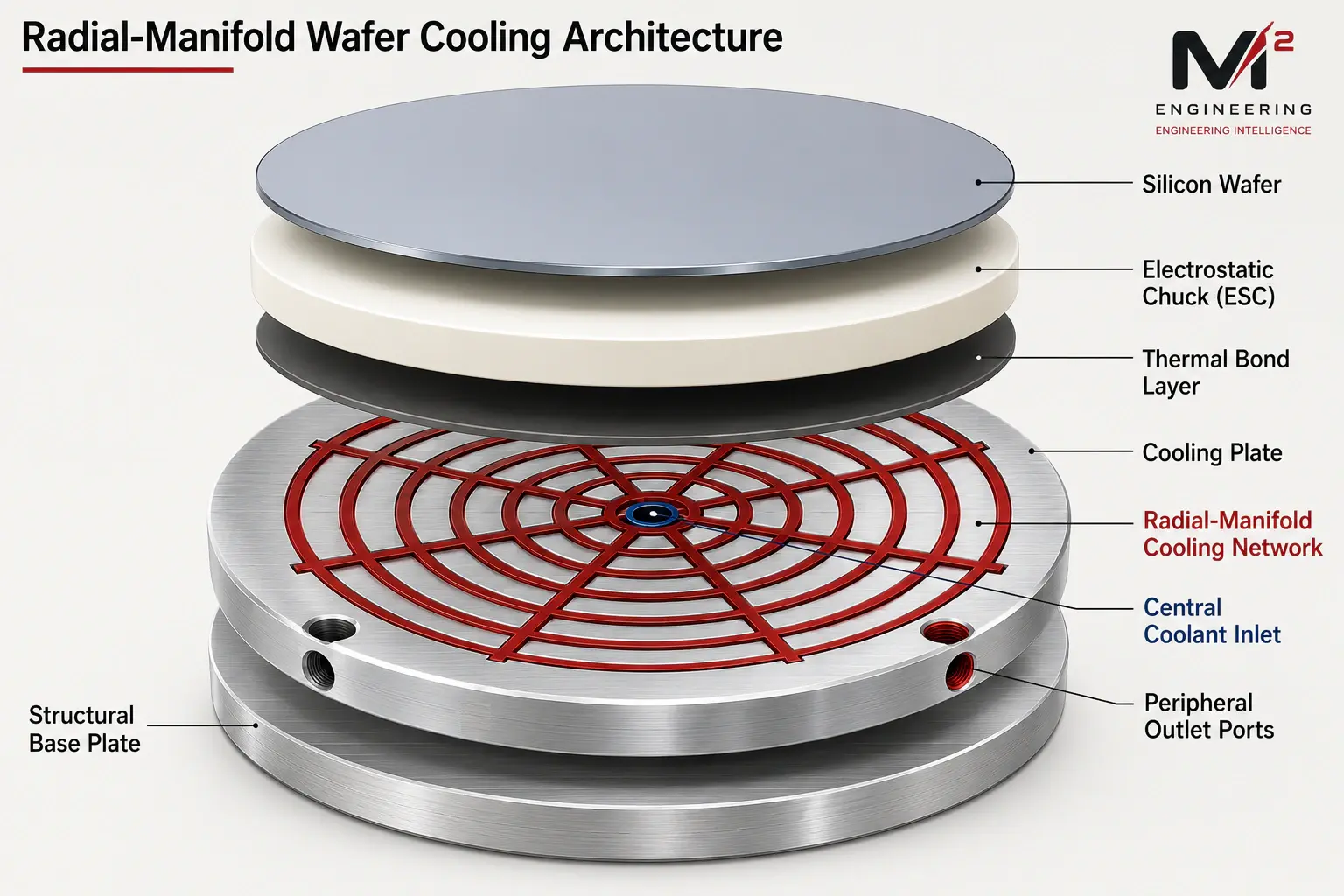
The proposed architecture consists of a multilayer wafer support assembly incorporating a dedicated liquid-cooling plate beneath the electrostatic chuck (ESC).
Exploded-view rendering of the wafer support assembly showing the silicon wafer, electrostatic chuck, thermal bond layer, cooling plate, radial-manifold cooling network, central coolant inlet, and four peripheral outlet ports.
The cooling plate employs a centrally supplied radial-manifold network composed of concentric coolant pathways connected through radial redistribution channels.
Unlike traditional serpentine cooling passages, the radial-manifold configuration is intended to distribute coolant symmetrically from the center toward the wafer perimeter while minimizing flow maldistribution.
Key architectural features include:
- Central coolant inlet
- Multiple concentric cooling manifolds
- Eight radial redistribution pathways
- Four peripheral outlet ports positioned at 90° intervals
- Symmetric coolant delivery across the wafer support area
This arrangement promotes balanced hydraulic loading and uniform coolant access to thermally critical regions.
Thermal Loading Environment
To evaluate cooling performance, a representative plasma heat-flux distribution was applied to the wafer surface.
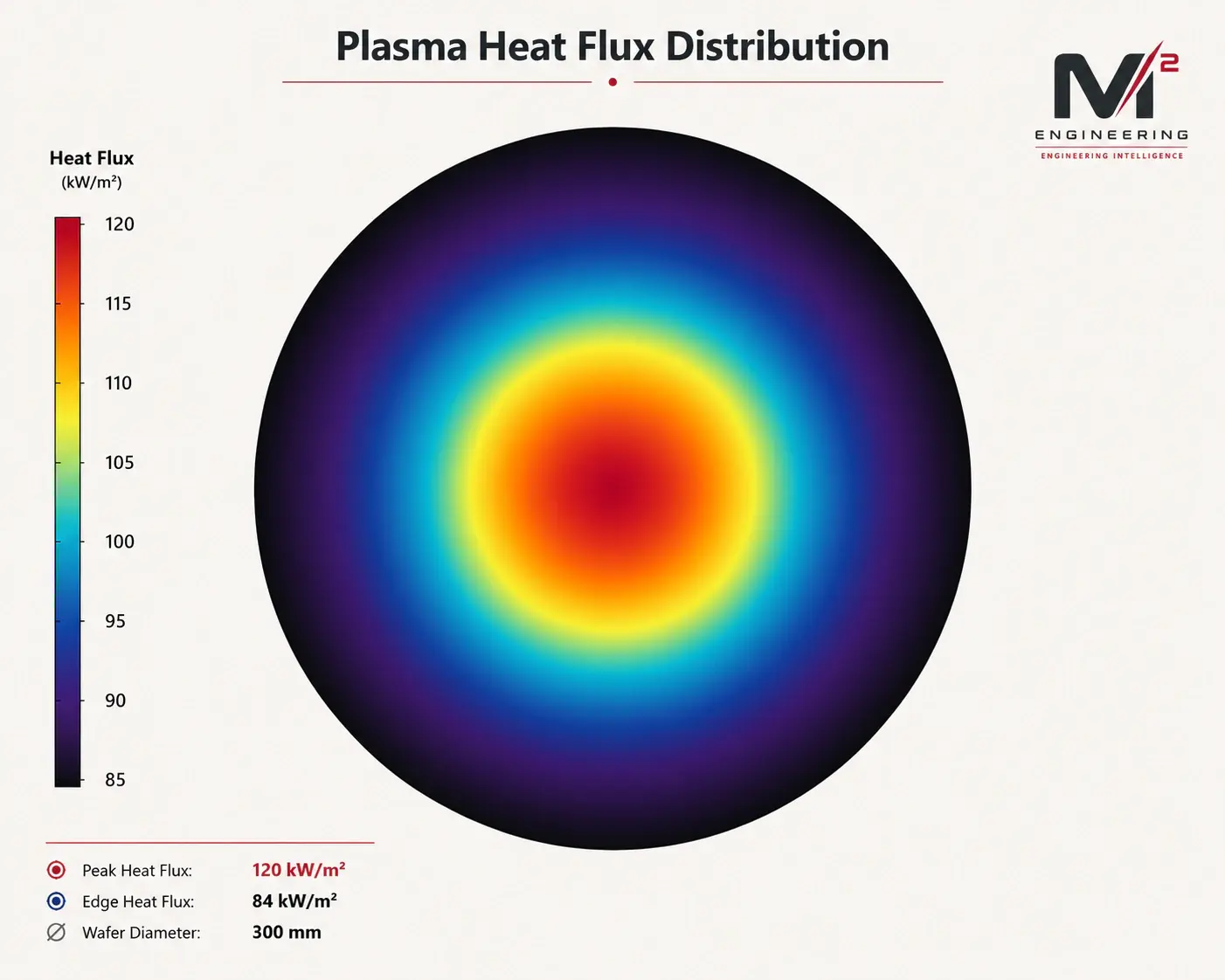
Axisymmetric plasma heat-flux profile applied to the wafer surface. Peak thermal loading occurs near the wafer center and gradually decreases toward the wafer edge.
The imposed thermal load represents a center-weighted plasma environment frequently encountered in semiconductor processing systems.
Key loading parameters:
- Wafer diameter: 300 mm
- Peak heat flux: 120 kW/m²
- Edge heat flux: 84 kW/m²
The resulting heat-flux profile creates a demanding cooling problem because the highest thermal loading coincides with the wafer center, where process sensitivity is often greatest.
Without adequate thermal management, this condition would typically generate significant temperature gradients and localized hotspots.
Coolant Redistribution Through the Radial Network
Cooling performance begins with effective coolant distribution.
Water enters the cooling plate through the central inlet and progressively absorbs thermal energy while traversing the manifold network before exiting through four peripheral outlet ports.
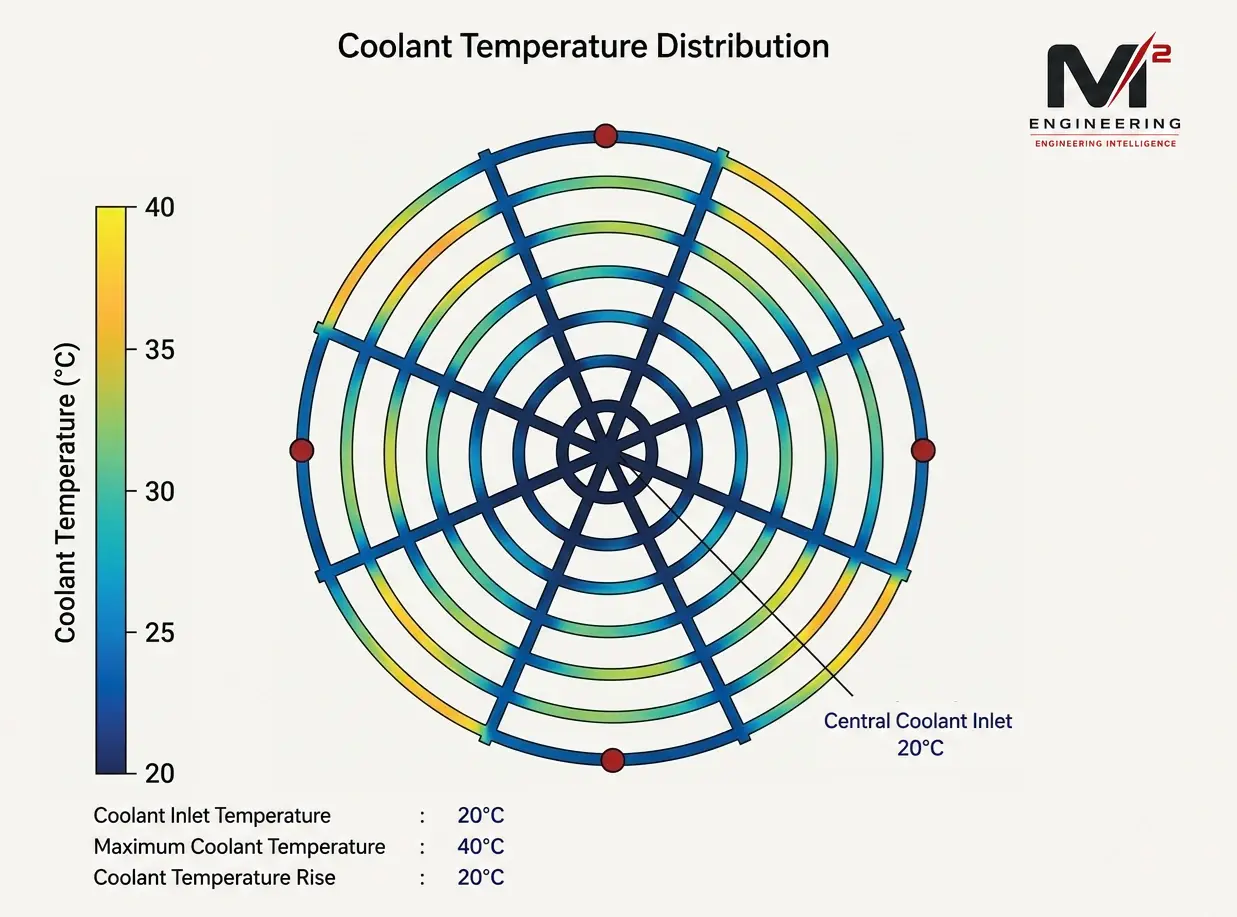
Predicted coolant temperature rise through the radial-manifold network as thermal energy is absorbed from the wafer support structure.
Simulation results indicate:
- Coolant inlet temperature: 20°C
- Maximum coolant temperature: 40°C
- Coolant temperature rise: 20°C
The temperature field demonstrates that thermal energy is distributed throughout the network rather than accumulating in isolated flow paths.
As coolant moves through successive manifold rings, its temperature increases gradually, indicating effective heat absorption and redistribution.
The symmetric warming pattern further suggests that the manifold architecture is successfully balancing coolant flow throughout the cooling plate.
Wafer Surface Temperature Response
The primary measure of cooling effectiveness is the resulting wafer temperature distribution.
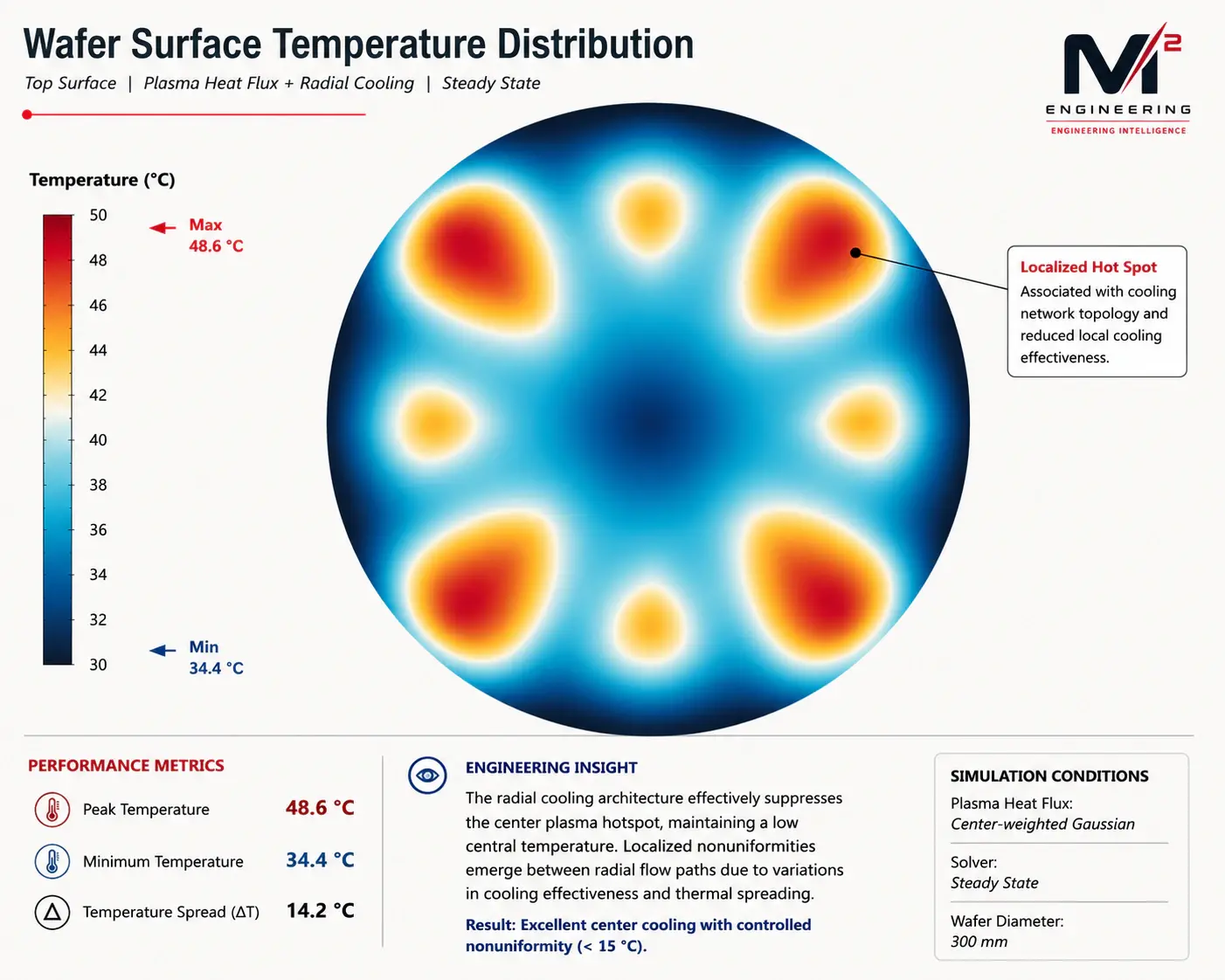
Predicted wafer temperature distribution resulting from coupled plasma heating and liquid cooling through the radial-manifold architecture.
Despite the concentrated thermal load applied at the wafer center, the radial-manifold network effectively suppresses central overheating.
Key thermal results include:
- Maximum wafer temperature: 48.6°C
- Minimum wafer temperature: 34.4°C
- Temperature spread: 14.2°C
One of the most significant observations is that the wafer center remains relatively cool despite receiving the highest heat flux.
This behavior is a direct consequence of the centrally supplied cooling architecture. By introducing coolant directly beneath the region of highest thermal loading, the design removes heat at its source before substantial thermal spreading can occur.
Localized temperature peaks remain visible between some radial flow pathways. These regions represent opportunities for future optimization of channel spacing, manifold geometry, and flow distribution.
Nevertheless, the overall temperature field demonstrates that the radial-manifold concept successfully addresses the primary thermal challenge associated with center-weighted plasma heating.
Hydraulic Performance
Thermal performance must always be evaluated alongside hydraulic cost.
A cooling architecture that achieves excellent heat removal but requires excessive pumping power may not be practical for industrial deployment.
For this reason, the pressure field was also evaluated.
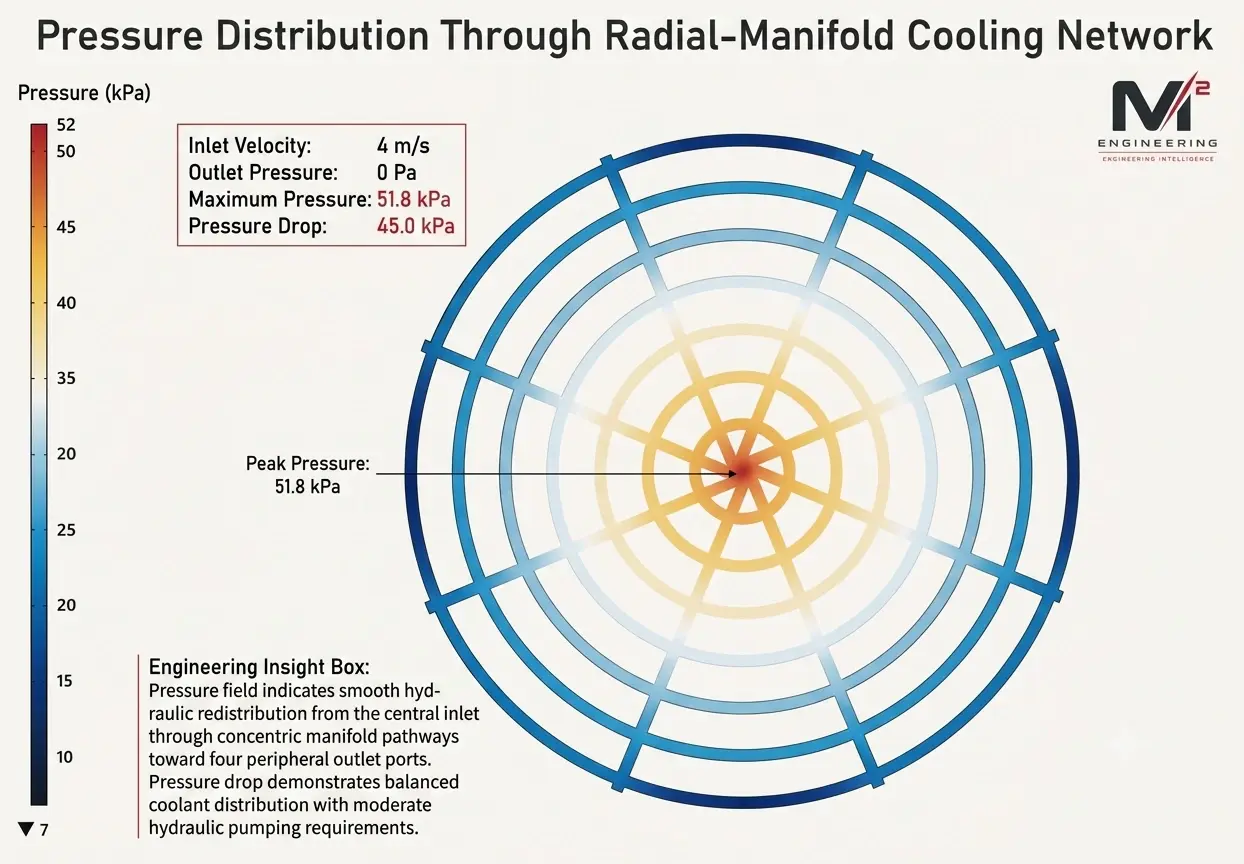
Hydraulic pressure distribution within the cooling plate under a 4 m/s inlet velocity boundary condition and 0 Pa outlet pressure boundary condition.
Simulation boundary conditions:
- Inlet velocity: 4 m/s
- Outlet pressure: 0 Pa (gauge)
Predicted hydraulic performance:
- Maximum pressure: 51.8 kPa
- Pressure drop: 45.0 kPa
The pressure field exhibits smooth decay from the central inlet toward the peripheral outlet ports.
No abrupt pressure discontinuities or severe hydraulic bottlenecks are observed.
The pressure distribution indicates that coolant is being redistributed uniformly through the concentric manifold structure while maintaining moderate pumping requirements.
This result is particularly important because it demonstrates that improved thermal performance is not achieved at the expense of excessive hydraulic losses.
Engineering Insights
Several important observations emerge from this study.
First, the radial-manifold architecture naturally aligns coolant delivery with the location of peak thermal loading. This is fundamentally different from many conventional cooling designs where coolant must travel significant distances before reaching thermally critical regions.
Second, the symmetric manifold arrangement promotes balanced flow redistribution throughout the cooling plate. The resulting temperature and pressure fields suggest effective hydraulic utilization of the available coolant.
Third, the architecture remains relatively simple from a manufacturing perspective. The network geometry consists primarily of concentric and radial features that can be produced using conventional machining processes.
Finally, the study highlights opportunities for further refinement. Future work may investigate:
- Channel pitch optimization
- Variable manifold spacing
- Nonuniform channel widths
- Alternative outlet configurations
- Flow balancing enhancements
- Multiphase cooling concepts
Conclusions
This Engineering Intelligence case study demonstrates the potential of radial-manifold cooling architectures for semiconductor wafer thermal management.
The design successfully:
- Delivers coolant directly to the region of highest thermal loading
- Limits peak wafer temperatures under plasma heating conditions
- Maintains acceptable temperature uniformity
- Achieves balanced hydraulic redistribution
- Operates with moderate pressure losses
The results suggest that radial-manifold cooling networks represent a promising alternative to traditional cooling approaches for next-generation semiconductor processing equipment.
As thermal loads continue to increase across advanced manufacturing platforms, engineering-driven cooling architectures will play an increasingly important role in maintaining process stability, equipment performance, and manufacturing yield.